
The 3 Days Serengeti Balloon Safari Itinerary & Holiday Package 2026–2027 combines one of Tanzania’s greatest wildlife destinations with a completely different perspective on the Serengeti: a professionally operated sunrise hot-air balloon safari above the plains, followed by traditional wildlife game drives on the ground.
Serengeti National Park protects more than 15,000 square kilometres of grassland, kopjes, woodland and riverine environments and supports the traditional Big Five—lion, leopard, elephant, buffalo and rhino—alongside cheetahs, hyenas, giraffes, zebras, gazelles and more than 500 recorded bird species. Tanzania National Parks also identifies Serengeti as home to the world’s largest terrestrial mammal migration, involving more than 1.5 million wildebeest together with zebras and other grazing animals. Tanzania Parks
Hot-air ballooning is an officially recognized Serengeti tourism activity. TANAPA regulates balloon operations within designated areas and requires approved operators and appropriate aviation qualifications, while the national park promotes sunrise balloon safaris as one of its signature visitor experiences. Tanzania Parks
A practical three-day road itinerary can follow:
Arusha → Ngorongoro Highlands → Serengeti National Park → Central Serengeti/Seronera → Sunrise Balloon Safari → Full Serengeti Game Drive → Morning Game Drive → Arusha
The experience develops naturally through:
Northern Tanzania countryside → Serengeti plains → lions and elephants → sunset safari → sunrise from the sky → Great Migration possibilities → Big Five search → final morning wildlife → Arusha.
For 2026–2027, the package works particularly well for travelers who have limited time but want more than a standard short Serengeti safari. Instead of spending all three days inside a vehicle, the balloon experience adds a panoramic view over the ecosystem while keeping traditional game drives as the main wildlife experience.
A three-day Serengeti itinerary is already one of Tanzania’s most recognizable short safari packages.
Adding a balloon experience changes its character completely.
The ground safari allows close observation of wildlife behavior, predators, kopjes, river systems and different habitats.
The balloon experience adds:
scale, sunrise light, aerial landscapes and a broad understanding of how enormous the Serengeti really is.
The two experiences complement rather than replace each other.
From the game vehicle, travelers may spend time with a lion pride resting beside a kopje.
From the balloon, the same landscape becomes part of a huge pattern of grassland, watercourses, woodland and animal trails extending toward the horizon.
The name Serengeti is commonly associated with the Maasai expression for endless plains, and the landscape explains why aerial viewing can be so visually powerful.
Central Serengeti contains a mixture of:
TANAPA specifically promotes hot-air balloon safaris as a way to experience the plains from above while the park remains internationally known for migration wildlife, predator concentrations and expansive scenery. Tanzania Parks
From the air, travelers may gain a better sense of:
Wildlife sightings from a balloon vary naturally and should never be guaranteed.
The strongest reason to choose the experience is the landscape itself.
Balloon flights operate from different parts of the greater Serengeti ecosystem according to season and operator.
One established operator’s current 2026 schedule lists Seronera throughout the year, with seasonal operations around Kirawira from roughly May to August, Kogatende from June to November and Ndutu from December to March. Miracle Experiences Partner Portal
This seasonal arrangement allows balloon experiences to be positioned in different landscapes during different periods of the Great Migration.
For a simple three-day itinerary from Arusha, Central Serengeti around Seronera is usually the most practical focus because balloon operations are available there year-round and the area also supports strong resident wildlife.
Central Serengeti is one of Tanzania’s strongest year-round game-viewing regions.
Even when major migratory herds have moved north, west or south, the Seronera ecosystem continues supporting resident:
One current balloon operator describes Seronera as its permanent year-round Serengeti base because of the area’s consistent wildlife and varied landscape. Miracle Experience
For a three-day holiday, that reliability matters.
Travelers do not need to chase migration movements across distant corners of the ecosystem simply to enjoy a strong Serengeti safari.
The Great Migration is one of the main reasons travelers dream of seeing Serengeti from the air.
TANAPA describes more than 1.5 million wildebeest, accompanied by zebras and other herbivores, moving through the wider Serengeti ecosystem. Tanzania Parks
However, the migration does not remain in one location throughout the year.
Broad seasonal movement may take herds through:
Southern Serengeti/Ndutu → Central Serengeti → Western Corridor → Northern Serengeti → southward return
depending heavily on rainfall and fresh grazing.
A balloon safari during migration season may therefore offer opportunities to see large concentrations of animals from above, but neither the exact herd location nor dramatic wildlife behavior can be promised.
Your 3 Days Serengeti Balloon Safari Holiday Package begins in Arusha, Tanzania’s principal gateway to the northern safari circuit.
After breakfast, meet your professional safari driver-guide and begin the journey toward Serengeti National Park.
The route gradually leaves the busy city and moves through the northern Tanzania countryside.
Depending on the selected road itinerary, the journey may pass through areas around Lake Manyara, Karatu and the Ngorongoro highlands before continuing toward the Serengeti.
The scenery changes repeatedly.
Cultivated countryside gives way to higher ground.
Highland forest may appear around parts of Ngorongoro.
Eventually, the environment becomes increasingly open.
Beyond the highlands, the vast Serengeti ecosystem begins to reveal itself.
Entering Serengeti National Park. TANAPA describes Serengeti as a landscape of more than 15,000 square kilometres with internationally important wildlife, the Big Five, large predator populations and the Great Migration. Tanzania Parks
Once inside the park, the transfer effectively becomes a game drive.
Possible wildlife may include:
Exact sightings depend completely on wildlife movement.
First Serengeti game drive. The afternoon provides your introduction to the park.
Instead of trying to cover enormous distances immediately, allow the landscape to unfold gradually.
Serengeti rewards observation.
A lion pride resting beside a kopje may remain in view for a long period.
A herd of elephants may cross open grassland.
Giraffes may feed along woodland edges.
Hyenas may move between grazing herds.
The first game drive also helps place tomorrow’s aerial experience into context.
Today you see the ecosystem from ground level.
Tomorrow you will see part of it from above.
Central Serengeti and kopjes. Rocky granite formations rise unexpectedly from sections of the plains.
These kopjes provide elevated resting and observation areas for wildlife and are particularly associated with predators such as lions.
TANAPA identifies kopjes as one of Serengeti’s characteristic scenic features. Tanzania Parks
Predator possibilities. Serengeti supports lions, leopards, cheetahs and hyenas. TANAPA specifically highlights the park’s concentration of carnivores as one of its principal wildlife attractions. Tanzania Parks
Lion sightings can be particularly rewarding in Central Serengeti.
Leopards remain more elusive and may use riverine trees and denser vegetation.
Cheetahs are strongly associated with more open landscapes.
No predator should be guaranteed.
Late-afternoon safari. As sunlight becomes softer, the grass changes color and wildlife photography becomes particularly attractive.
Possible scenes include:
Continue toward your lodge or tented camp.
For a three-day balloon itinerary, accommodation location matters significantly.
A property reasonably positioned for the selected balloon operation reduces unnecessary transfers and keeps the following morning more efficient.
Enjoy dinner and the first night inside or near the Serengeti wilderness.
Overnight: Central Serengeti / Seronera area or corresponding seasonal balloon region
Main Experience: Arusha to Serengeti journey, first wildlife encounters, predators, plains and sunset game viewing
Day 2 is the signature day of the entire package.
The morning combines a professionally managed balloon experience with the traditional Serengeti safari that continues afterward.
Balloon operations are dependent on suitable weather conditions and professional operational decisions. TANAPA regulates approved balloon safari activity within national parks, while commercial operators may cancel or reschedule flights when conditions are unsuitable. Tanzania Parks
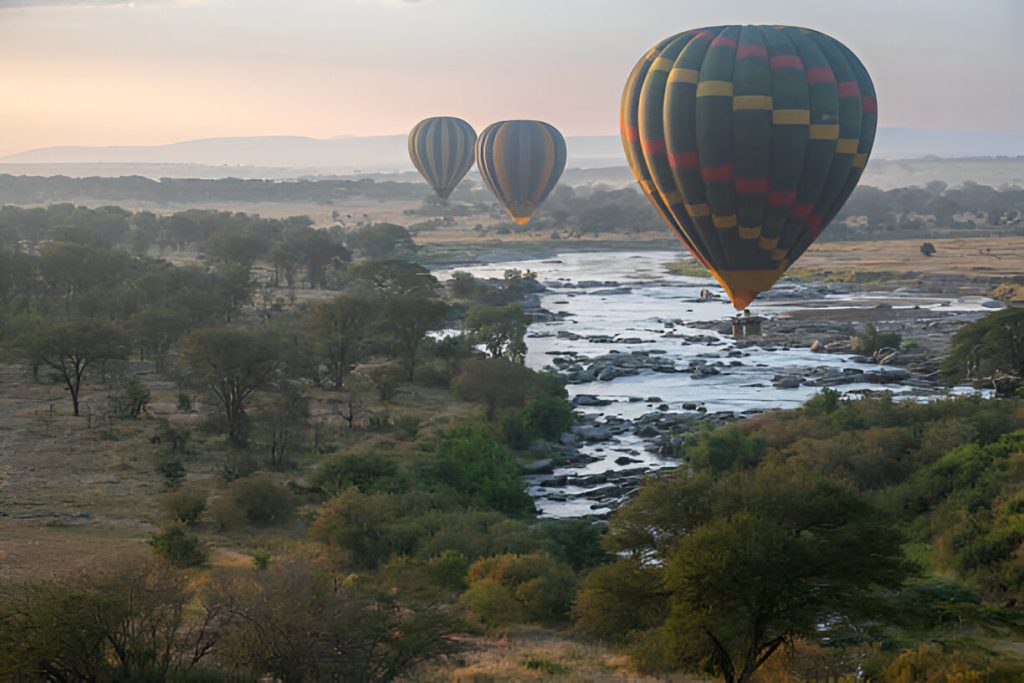
The sunrise experience. Serengeti balloon safaris are designed around the early-morning period, when the light across the plains is particularly dramatic.
Rather than focusing on technical flight operations, allow the experience to be about perspective.
As the balloon moves over part of the Serengeti landscape, the environment below may reveal:
The exact route cannot be predetermined like a road game drive because balloon movement depends on operating conditions.
That unpredictability is part of the experience.
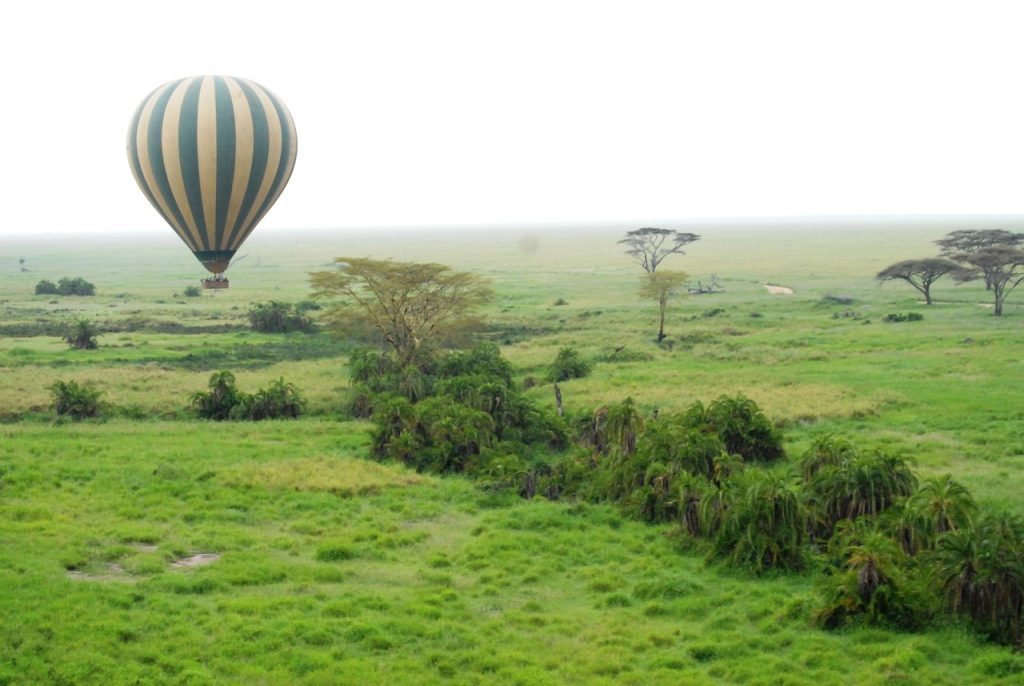
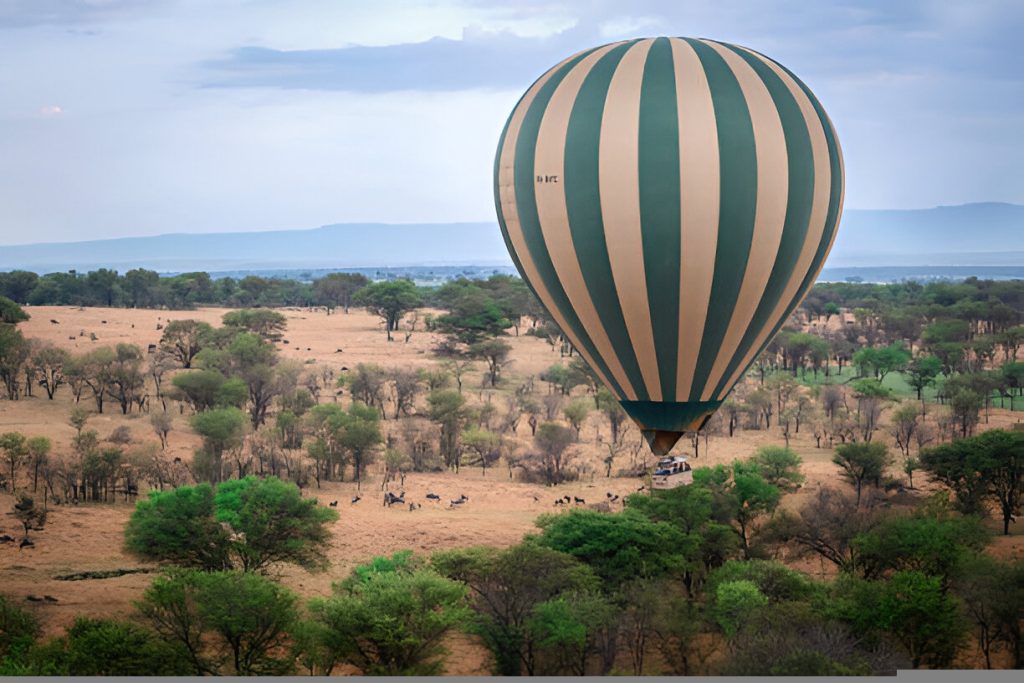
Seeing the Serengeti from above. What often becomes most impressive is not one individual animal but the scale of the ecosystem.
Roads that seemed substantial from the safari vehicle become thin lines.
Kopjes appear as small islands of rock.
Animal trails become visible across the grass.
Large herds may form patterns that cannot be appreciated as easily from ground level.
Even when wildlife is not directly below the balloon, the aerial landscape remains the main attraction.
Wildlife possibilities from the air. Depending on area and season, travelers may have opportunities to observe animals such as:
Predators may also occasionally be visible, but seeing a lion, leopard or cheetah from the balloon should never be promised.
The strongest balloon safari expectation is:
Serengeti landscape first, wildlife as a natural bonus.
Balloon experience duration. One current Serengeti operator lists the aerial portion at roughly one hour, with some variation according to conditions. Its wider experience includes transfers associated with the balloon program and a post-flight bush breakfast. Miracle Experiences Partner Portal
This structure means the balloon safari occupies an important part of the morning without using the entire day.
Bush breakfast. After the professionally operated flight concludes, current Serengeti balloon packages commonly include a breakfast experience in the bush.
This provides a relaxed transition from the aerial experience back into the ground safari.
The morning therefore moves through:
sunrise → aerial Serengeti → landing → breakfast → game drive.
After breakfast, reunite with your safari driver-guide and continue exploring the park.
Full Serengeti game drive. Now the safari changes completely.
Animals that appeared small from the air become individual personalities again.
A giraffe can be observed feeding.
An elephant family can be watched communicating.
A lion pride may rest only a short distance from the road.
This difference between aerial scale and ground-level detail is exactly what makes the balloon-and-game-drive combination so powerful.
Searching for the Big Five. Serengeti supports all five traditional Big Five species:
TANAPA confirms all five occur within the park. Tanzania Parks
However, seeing all five during a three-day safari should not be guaranteed.
Rhinos are much more restricted and difficult to locate than many other Serengeti animals.
Leopards can also remain hidden.
A strong safari should be evaluated by the quality of wildlife encounters rather than simply completing a list.
Lion country. Serengeti is particularly famous for lions.
TANAPA currently describes the park as supporting more than 3,000 lions. Tanzania Parks
Possible experiences include:
Spend time watching behavior when possible.
A relaxed twenty-minute observation can reveal much more than simply stopping long enough to take one photograph.
Cheetahs. Open Serengeti plains provide suitable environments for cheetahs.
Possible observations may include individuals resting on elevated ground, scanning grazing herds or moving through open grass.
Sightings remain natural and unpredictable.
Leopards. Leopards may use riverine woodland and trees, especially in areas providing cover.
They are far more secretive than lions and should be treated as a bonus rather than an expectation.
Elephants. Elephant families provide some of Serengeti’s most memorable wildlife encounters.
Possible behavior includes feeding, walking, social interaction and young animals remaining close to adults.
Environmental photographs showing elephants within the open Serengeti can be especially powerful.
Buffalo. Large buffalo herds may be encountered in suitable areas.
Individuals can also occur separately from the main herd.
Wildebeest and zebra. During periods when major migration herds are close to the chosen safari area, these species may dominate the landscape.
Outside major migration periods, resident populations remain.
The Great Migration should never be marketed as though millions of animals occupy Central Serengeti every month of the year.
Midday wildlife and landscape. Continue according to current wildlife conditions.
The exact route should depend on:
A flexible safari is stronger than one that insists on reaching a predetermined point regardless of what is happening nearby.
Afternoon game viewing. Later in the day, softer light returns.
Wildlife may become more active as temperatures decline.
Search across plains, woodland and riverine habitats.
Watch for giraffes feeding, elephants moving toward water, predators becoming more alert and herds shifting across grassland.
Eventually, return toward your accommodation.
This has been the most varied day of the entire package:
Balloon safari + bush breakfast + full Serengeti game drive + sunset wilderness.
Enjoy dinner and your second night in Serengeti.
Overnight: Serengeti National Park
Main Experience: Sunrise balloon safari, aerial Serengeti landscapes, bush breakfast, Big Five search, predators and full-day wildlife viewing
Wake for one final morning inside the Serengeti ecosystem.
A three-day trip becomes particularly valuable because Day 3 provides another wildlife period before the return journey.
Perhaps lions were inactive yesterday.
Perhaps a leopard remained hidden.
Perhaps elephants were distant.
The final morning creates another opportunity, but the safari should not become a race to complete a checklist.
Begin with a game drive according to accommodation location and the route toward the park exit.
Morning conditions may provide opportunities to see:
TANAPA records more than 500 bird species across the Serengeti ecosystem, including raptors, ostriches and numerous grassland and wetland species. Tanzania Parks
Birdlife therefore remains valuable even during periods when large mammals are resting.
Final predator search. If the safari has not yet produced a meaningful predator encounter, the morning may concentrate on likely habitats based on guide knowledge and recent wildlife activity.
However, there is never a guarantee.
A leopard might remain invisible for the entire trip.
A cheetah may be several kilometres from yesterday’s location.
Lions may move overnight.
This unpredictability is part of an authentic safari.
One final look across the plains. After seeing the Serengeti from above on Day 2, the final ground safari can feel different.
You now understand the scale more clearly.
The plains are no longer simply a road surrounded by wildlife.
They are part of an enormous functioning ecosystem extending far beyond what can be seen from the vehicle.
Begin the return journey toward the Ngorongoro highlands and onward toward Arusha.
For a road-based three-day itinerary, Day 3 can be long.
Travelers who want to reduce driving can instead structure the overall package around a scheduled flight from a Serengeti airstrip, depending on budget and availability.
The standard road package remains attractive for travelers who want to see the changing landscapes between Serengeti and Arusha.
Continue through northern Tanzania and arrive at your agreed destination.
Your 3 Days Serengeti Balloon Safari Itinerary & Holiday Package 2026–2027 then comes to an end.
Main Experience: Final Serengeti game drive, morning wildlife and return journey to Arusha
Balloon pricing is operator-specific and should always be confirmed for the actual travel date.
One established Serengeti operator’s published 2026 rack rate is US$599 per person for Serengeti National Park. Its listed rate includes the balloon experience, applicable balloon concession charges and VAT, associated lodge pickup, post-flight breakfast and related service elements. Miracle Experiences Partner Portal
This US$599 figure is the balloon component only, not the entire three-day Serengeti safari package.
The full three-day holiday price can additionally include:
For 2027, the balloon price should be reconfirmed when the operator’s applicable tariff is released rather than assuming the 2026 price will remain unchanged.
A common mistake is seeing a balloon price online and assuming that figure represents the complete Serengeti trip.
It does not.
The safari requires transportation into one of Tanzania’s largest and most remote national parks.
A complete road package may need:
private 4×4 + guide + fuel + park entry + accommodation + meals + transit fees + balloon reservation.
Accommodation level can also change the final package substantially.
A practical tented camp provides a different price from a high-end lodge or luxury mobile camp.
Group size matters because vehicle and guide expenses can be shared.
A more affordable package generally combines the balloon experience with practical safari accommodation and shared operating costs.
The balloon portion itself remains a premium activity.
Savings usually come from:
Travelers should compare the complete package rather than simply looking at the room price.
Mid-range travel is often the strongest balance for a three-day package.
It can provide:
For such a short holiday, location is especially valuable.
A well-positioned camp can preserve more wildlife time and reduce unnecessary transfers.
Luxury arrangements may add:
However, real luxury in Serengeti is often:
time + location + excellent guiding + privacy + fewer unnecessary transfers.
A very expensive room does not automatically provide better wildlife.
The experience can be arranged in different Serengeti regions according to season.
A current 2026 operator schedule lists:
Seronera – year-round
Kirawira – approximately May to August
Kogatende – June to November
Ndutu – December to March
with additional operations in selected areas. Miracle Experiences Partner Portal
These locations broadly correspond with different phases of the Serengeti migration cycle.
However, rainfall can shift herd movements.
A balloon flight from a seasonally appropriate area improves the possibility of seeing migratory herds but never guarantees that huge concentrations will pass directly below.
Central Serengeti is the strongest choice for travelers who value consistent wildlife throughout the year.
Seronera contains:
Current operators maintain year-round balloon bases there. Miracle Experience
For a standard three-day itinerary from Arusha, this is usually the simplest and most balanced option.
Northern Serengeti becomes particularly attractive during the broader mid-year migration season.
Kogatende operations are commonly seasonal from around June through November. Miracle Experiences Partner Portal
The landscape can include:
River crossings should never be guaranteed.
A balloon safari provides a landscape perspective rather than a scheduled crossing experience.
The Western Corridor around Kirawira and the Grumeti system can become important as migration herds move west and northwest.
Current balloon operations are offered seasonally during parts of approximately May through August. Miracle Experiences Partner Portal
The Western Corridor provides a different environment from Central Serengeti, with stronger riverine influence and woodland in parts of the landscape.
From roughly December through March, some balloon operators position seasonal operations around the Ndutu area. Miracle Experiences Partner Portal
The southern ecosystem becomes particularly important during the broader calving season.
Travelers should understand that Ndutu extends across the wider Serengeti–Ngorongoro ecosystem and is not simply another permanent Central Serengeti location.
The seasonal positioning helps match the balloon experience with wildlife movement.
For travelers whose budget allows it, the balloon experience adds something a game drive cannot reproduce.
The strongest differences are:
perspective, silence, sunrise and scale.
From a vehicle, you experience individual wildlife encounters.
From the air, you experience the ecosystem as a landscape.
The two work particularly well together.
A balloon safari should not replace your main game drives.
It should enhance them.
Travelers sometimes ask whether they should spend the money on the balloon or simply add more game-drive time.
The answer depends on priorities.
Choose the balloon experience if the main goals include:
Choose additional game-drive time if the main priority is:
For the strongest three-day itinerary, combining both provides the best balance.
Balloon activity is weather-dependent.
Commercial operators can cancel a flight when conditions are unsuitable, and current operator policies recognize weather cancellation as a normal possibility. Miracle Experience
This is an important part of planning.
A balloon safari should therefore never be described as absolutely guaranteed simply because it has been reserved.
Professional operational decisions take priority.
If the balloon activity cannot take place, the surrounding Serengeti game-drive safari still remains highly rewarding.
TANAPA has formal operational guidelines governing balloon safaris inside Tanzania’s national parks.
These guidelines address approved operating areas, operator requirements and regulatory oversight, including coordination with park management and relevant aviation qualifications. Tanzania Parks
Travelers should only participate through officially authorized commercial operations and follow the operator’s current instructions and restrictions.
This is a professionally managed tourism activity rather than an independent adventure activity.
TANAPA confirms that Serengeti supports:
Lion
Leopard
Elephant
Buffalo
Rhino Tanzania Parks
Yet their distribution is not equal.
Lions can be relatively prominent in productive Serengeti habitats.
Elephants and buffalo are widespread across suitable areas.
Leopards remain secretive.
Rhinos are much more restricted.
Seeing all five within three days is therefore possible but should not be expected as a guaranteed outcome.
The park is internationally famous for carnivores.
TANAPA highlights:
among the major attractions. Tanzania Parks
These predators benefit from the enormous populations of herbivores occupying the ecosystem.
Migration season can create exceptional predator-prey dynamics, but strong predator viewing also occurs outside the main migration concentrations.
Serengeti is not only a mammal destination.
TANAPA currently records more than 500 bird species. Tanzania Parks
Possible groups include:
Aerial viewing can reveal the overall habitat mosaic, while ground game drives provide a much better opportunity for detailed birdwatching.
Binoculars therefore remain useful even in a balloon-focused safari package.
The strongest photography comes from understanding the different strengths of each perspective.
From the balloon, focus on:
From the safari vehicle, focus on:
This creates a more complete photographic story.
Instead of returning home with only close animal portraits, travelers can show:
where the animals live and how enormous the Serengeti landscape really is.
There is no single best month for every traveler.
The right period depends on whether the priority is:
migration + predators + calving + landscape + fewer crowds + general year-round wildlife.
TANAPA highlights January and February for the broader calving season. Tanzania Parks
Southern ecosystem balloon operations may align with this seasonal wildlife concentration.
The southern ecosystem may remain important, although migration movement depends increasingly on rainfall.
Greener landscapes and dramatic clouds can create beautiful aerial scenery.
Rain can affect road and aviation conditions, so flexibility matters.
Migration movement generally becomes more important toward western and northern sections.
TANAPA identifies June through October as a major dry-season wildlife and migration period. Tanzania Parks
Northern and western balloon locations may become particularly relevant.
Seasonal rains can refresh the landscape and influence migration movement southward.
Central Serengeti remains a strong year-round option.
A balloon safari can work especially well for couples seeking an experience beyond ordinary game drives.
The combination of:
sunrise + aerial plains + bush breakfast + full safari day
creates a memorable centerpiece within a wider Tanzania holiday.
A private safari vehicle afterward can provide additional flexibility and privacy.
Family suitability depends on the current rules of the selected licensed operator, including age, height and other participation requirements.
Those requirements should be checked before confirming the package.
Families who do not use the balloon component can still enjoy a complete Serengeti itinerary through professionally guided game drives.
For photographers, the balloon experience is primarily about environmental storytelling.
From the air, use the landscape itself:
The balloon is not the best environment for every kind of close wildlife photography.
That is why the full-day ground safari after the flight remains so valuable.
Travelers with additional days can create a stronger northern Tanzania itinerary:
Arusha → Serengeti → Balloon Safari → Ngorongoro Crater → Arusha
Ngorongoro introduces a very different environment.
Serengeti provides vast open ecosystems.
Ngorongoro concentrates wildlife within an enormous volcanic caldera.
Additional days are recommended so neither destination becomes rushed.
Another longer itinerary can become:
Tarangire → Serengeti → Balloon Safari → Ngorongoro
Tarangire introduces:
Serengeti introduces:
Ngorongoro adds:
This works particularly well as a five- to seven-day northern Tanzania safari.
One of Tanzania’s strongest safari-and-beach combinations is:
Serengeti Balloon Safari → Zanzibar
Serengeti provides:
Zanzibar provides:
The contrast creates an excellent honeymoon, couples or general holiday itinerary.
A three-day road package usually provides stronger value but requires substantial driving.
A fly-in package costs more but protects time.
Best for travelers who want:
Best for travelers prioritizing:
A fly-in itinerary can be particularly valuable when only three days are available.
What is a Serengeti balloon safari? It is an officially regulated hot-air balloon tourism experience offering an aerial view over designated Serengeti landscapes, normally combined with a traditional ground safari. TANAPA recognizes balloon safaris as an official Serengeti activity. Tanzania Parks
How long does a Serengeti balloon flight last? One current 2026 operator lists the aerial portion at approximately one hour, with some variation according to conditions. Miracle Experiences Partner Portal
How much does a Serengeti balloon safari cost in 2026? One established operator’s published 2026 rack rate is US$599 per person in Serengeti National Park. The price includes the operator’s stated balloon-related services, concession and VAT. Miracle Experiences Partner Portal
Will the balloon cost remain US$599 in 2027? Not necessarily. The 2027 price should be reconfirmed once the applicable operator rates are published.
Is US$599 the price of the entire 3-day safari? No. It is a current balloon-activity reference from one operator. The complete safari also involves accommodation, transport, guide, park fees, meals and other trip costs.
Where do Serengeti balloon safaris operate? Current operations include year-round flights around Seronera and seasonal operations in areas such as Kirawira, Kogatende and Ndutu. Miracle Experiences Partner Portal
Can I take a balloon safari in Central Serengeti all year? Current operators advertise year-round Seronera operations. Miracle Experience
Can I take a balloon safari during the Great Migration? Yes. Seasonal balloon bases can align with different migration regions, but exact herd locations remain dependent on rainfall and natural movement.
Will I see the Great Migration from the balloon? It is possible when migratory herds are within the flight area, but it cannot be guaranteed.
Will I see a river crossing from the balloon? River crossings are unpredictable wildlife events and should never be guaranteed.
Can I see lions from the balloon? Lions may be visible under suitable circumstances, but no specific wildlife species should be promised from an aerial safari.
Can I see elephants? Elephants occur throughout Serengeti and may be observed from the balloon or during game drives depending on natural movement.
Can I see the Big Five in Serengeti? Yes. TANAPA confirms lion, leopard, elephant, buffalo and rhino occur in Serengeti National Park. Tanzania Parks
Can I see all Big Five in three days? It is possible but not guaranteed. Leopard and rhino can be particularly challenging to find.
Is Serengeti good for lions? Yes. TANAPA currently describes Serengeti as supporting more than 3,000 lions. Tanzania Parks
How many bird species are found in Serengeti? TANAPA records more than 500 bird species. Tanzania Parks
Is the balloon safari weather-dependent? Yes. Balloon operators may change or cancel operations when conditions are unsuitable. Miracle Experience
Are balloon safaris regulated? Yes. TANAPA has operational guidelines governing balloon tourism inside Tanzania’s national parks and approved activity areas. Tanzania Parks
Is the balloon safari available every day? Year-round operations are advertised in Central Serengeti, but each actual flight remains subject to conditions and operator decisions. Miracle Experience
Is Seronera good for balloon safaris? Yes. Seronera is a year-round operational area and provides strong resident wildlife and varied central Serengeti landscapes. Miracle Experience
What is the best month for a Serengeti balloon safari? There is no single best month. Central Serengeti is a year-round option, while seasonal bases may be better positioned for certain migration phases.
Is January good for balloon safari? Yes. Southern ecosystem wildlife and the broader calving season can make this period particularly interesting.
Is August good? Yes. August falls within the broader dry and migration season and may be particularly relevant for northern Serengeti.
Is October good? Yes. Northern areas may still be important for migration, while Central Serengeti remains productive.
Is December good? Yes. Seasonal rainfall can refresh the plains and migration movement can increasingly shift toward southern areas.
Is three days enough for Serengeti? Three days provides a strong short safari with two nights, several ground-game-drive periods and the balloon experience. Longer stays provide substantially more time for photography and wider exploration.
Can I drive from Arusha? Yes. Road safaris from Arusha are common, although the journey is substantial.
Can I fly into Serengeti? Yes. Regional airstrips serve the park, and fly-in packages can reduce transfer time.
Can I combine the balloon safari with Ngorongoro? Yes, but additional days are recommended.
Can I combine Serengeti with Zanzibar? Yes. Serengeti wildlife followed by Zanzibar beach time creates one of Tanzania’s most popular safari-and-beach combinations.
Is wildlife guaranteed? No. Serengeti is a natural ecosystem, and all wildlife movement and behavior remain unpredictable.
The itinerary succeeds because each day feels different.
Day 1 becomes:
Arusha → Ngorongoro Highlands → Serengeti → first predators → sunset.
Day 2 becomes:
Sunrise → balloon safari → Serengeti from above → bush breakfast → Big Five game drive → sunset.
Day 3 becomes:
Final morning wildlife → last Serengeti landscapes → Arusha.
Within three days, travelers experience:
road safari + aerial safari + predators + Big Five possibilities + Great Migration possibilities + sunrise + sunset + northern Tanzania scenery.
The balloon experience does not replace the wildlife safari.
It makes the ground safari feel larger because travelers have already seen the ecosystem from an entirely different perspective.
The most important planning decisions are the travel date, group size, preferred Serengeti region, accommodation category and whether the itinerary will be road-based or fly-in.
Travel dates also influence the most suitable balloon location.
Central Serengeti around Seronera provides year-round operations, while current 2026 commercial schedules show seasonal options around Ndutu, Kirawira and Kogatende corresponding broadly with different phases of wildlife movement. Miracle Experiences Partner Portal
For the balloon activity itself, one current operator lists US$599 per person for Serengeti in 2026. This should be treated as a current operator reference rather than a permanent Serengeti-wide price. Miracle Experiences Partner Portal
For 2027, all rates should be reconfirmed before a final holiday quotation is issued.
The 3 Days Serengeti Balloon Safari Itinerary & Holiday Package 2026–2027 offers two completely different ways to experience Tanzania’s most famous national park.
Begin in Arusha and travel across northern Tanzania toward the Serengeti.
By afternoon, the endless plains surround you.
Lions rest beside granite kopjes.
Elephants cross the grasslands.
Giraffes rise above woodland.
Zebras and wildebeest move across the horizon.
Spend your first night inside the wilderness.
The following morning, the perspective changes.
The Serengeti opens beneath you.
Rivers curve across the landscape.
Kopjes become islands of stone.
Wildlife trails spread across the grass.
During migration periods, grazing herds may transform whole sections of the plains.
After the aerial experience and bush breakfast, return to the ground and spend the rest of the day searching for lions, leopards, cheetahs, elephants, buffalo, giraffes and the other species that make Serengeti one of the greatest wildlife destinations on Earth.
Spend one final night surrounded by the sounds of the park.
Then wake for another morning game drive before returning toward Arusha.
The complete journey follows:
Arusha → Ngorongoro Highlands → Serengeti National Park → First Game Drive → Sunrise Balloon Safari → Bush Breakfast → Full-Day Serengeti Safari → Final Morning Game Drive → Arusha
For 2026–2027, the holiday can be customized around road or fly-in travel, budget, mid-range or luxury accommodation, Central or seasonal Serengeti balloon regions, wildlife photography, couples, families and longer Tanzania safari-and-beach combinations.
Share the preferred travel dates, number of travelers and accommodation level so the package can be structured around the appropriate Serengeti region, current park charges and balloon rates.
The three-day experience can remain focused entirely on Serengeti or become part of a longer northern Tanzania journey combining Tarangire, Ngorongoro, Serengeti and Zanzibar.
Travel across Tanzania’s legendary plains by safari vehicle, then experience the same wilderness from a completely different perspective during a professionally operated sunrise balloon safari above the Serengeti, before returning to the ground for another full day among Africa’s most celebrated wildlife.
✅ Domestic flight from Arusha to Serengeti and return
✅ 2 nights full board accommodation in Serengeti
✅ Private game drives in 4×4 safari vehicle
✅ Hot air balloon safari with champagne breakfast
✅ Park entrance and balloon fees
✅ Professional English-speaking driver-guide
✅ Bottled water during game drives
✅ All government taxes and levies
Neutral-colored clothing
Binoculars & camera
Sunscreen & sunglasses
A warm layer for early morning balloon flight
Travel documents and personal medications
The Serengeti balloon safari operates year-round, but the best experience depends on the location of the Great Migration:
December – March: Southern Serengeti (calving season)
June – July: Western Corridor (Grumeti River crossings)
August – October: Northern Serengeti (Mara River crossings)
Balloon flights typically depart from Central Serengeti (Seronera) but can be arranged from other areas depending on seasonal migration movements.
Q: Is the Serengeti balloon safari safe?
A: Yes, balloon safaris are operated by licensed and experienced pilots with strict safety standards.
Q: How long does the balloon ride last?
A: Approximately 1 hour, followed by a champagne bush breakfast.
Q: Can children join the balloon safari?
A: The minimum age is generally 7 years old, and children must be accompanied by adults.
Q: What if the balloon ride is canceled due to weather?
A: In the rare event of cancellation, you’ll receive a full refund for the balloon activity or be offered a rescheduled flight if possible.
This 3 days Serengeti balloon safari itinerary is perfect for:
Short vacationers wanting a high-impact safari
Couples on honeymoon or anniversary trips
Luxury travelers and wildlife photographers
Those seeking a mix of adventure and comfort
Don’t miss out on this dream adventure. The 3 days Serengeti balloon safari tour offers an unmatched blend of aerial and ground wildlife experiences in Africa’s most legendary national park. Watch the golden sunrise light up the plains as wildlife stirs below—it’s a moment you’ll never forget.
📍 Start/End: Arusha
🚗 Transport: Flights + Safari Vehicle
🏕️ Accommodation: Tented Camp or Lodge
📅 Availability: Year-round
👉 Contact us now to reserve your seat in the skies of Serengeti with this incredible 3 Days Serengeti Balloon Safari Itinerary.
No results available
ResetNo results available
ResetTanzania is a year-round safari destination with many adventures being offered all over the country. For optimal wildlife sightings, the dry season from June to October is your best bet! Read more on when to visit Tanzania
Both have their perks with Big Five national parks, the incredible Great Migration and that quintessential African experience we all dream of. Check out our article on Serengeti vs Masai Mara to help you decide.
They both have such different safari experiences! Tanzania offers Big Five game reserves on classic dusty desert plains, rather South Africa partners the Big Five animals with luscious winelands. Both are just as good, but it depends on your safari style.
That’s a tough one! Botswana is home to herds of elephants at Chobe and the sparkling Okavango Delta, and Tanzania has the iconic Mount Kilimanjaro and Great Migration. Check out our article on Botswana vs Tanzania safaris to help you decide.
Tanzania is in general a safe, hassle-free country. However, like most places, you do need to take precautions and listen to your tour guide. It also pays to read our articles on ‘Things to know before going to Tanzania’.
A camera and binoculars are a must. You’ll regret it if you don’t take them! As for clothing, definitely pack lightweight, breathable clothing. Remember, Tanzania is an arid country so the days can get quite hot. Read more on what to pack for a safari in Tanzania in our travel magazine
EXPERIENCES
BEST TOURS
copyright©2026 . Enjore Safaris