
The 13-Day Highlights of Namibia Small Group Tour is designed for travelers who want to experience the extraordinary contrasts of Namibia without spending their holiday constantly packing, driving and rushing from one attraction to another.
This journey combines the landscapes that make Namibia unforgettable: red Kalahari sands, the towering dunes of Sossusvlei, the Atlantic coast at Swakopmund, ancient rock art in Damaraland and the wildlife-rich waterholes of Etosha National Park.
The route begins in Windhoek, where the group meets and prepares for the journey ahead.
From the capital, the landscape opens into the Kalahari, introducing Namibia through red dunes, wide horizons and a sense of space that will remain one of the defining features of the tour.
The journey then turns west toward the Namib Desert, where the enormous dunes around Sossusvlei and Deadvlei create some of Africa’s most recognizable landscapes.
Namibia Tourism describes Sossusvlei as a vast clay-and-salt pan surrounded by deep orange dunes, while nearby Deadvlei is famous for its dark, skeletal camel-thorn trees standing against a pale clay floor and towering dunes. Visit Namibia
From the desert, the tour reaches the Atlantic at Swakopmund, where cool coastal air creates a remarkable contrast with the dry interior. Namibia Tourism describes Swakopmund and nearby Walvis Bay as places where the desert meets the sea and as major centres for coastal and adventure experiences. Visit Namibia
The journey then continues north into Damaraland, a region of rugged mountains, dry valleys and ancient cultural landscapes.
Here, travelers visit Twyfelfontein or /Ui-//aes, one of Africa’s important concentrations of prehistoric rock engravings and a UNESCO World Heritage Site. UNESCO recognizes the site for its extensive record of hunter-gatherer ritual practices extending over at least two millennia. UNESCO World Heritage Centre
The final major chapter is Etosha National Park, Namibia’s flagship wildlife destination.
Etosha supports 114 recorded mammal species and more than 400 bird species, including elephants, black and white rhinos, lions, giraffes, leopards, zebra and many antelope species. Visit Namibia
The complete journey therefore develops naturally:
Windhoek → Kalahari → Namib Desert → Sossusvlei → Atlantic Coast → Damaraland → Ancient Rock Art → Etosha Wildlife → Windhoek.
It is this gradual transition—from desert to ocean, culture to wildlife—that makes the tour more memorable than simply moving between famous attractions.
A small group tour should provide more than shared transportation.
The strength of this itinerary comes from combining a carefully planned route with enough time to understand what you are seeing.
Namibia is vast.
A poorly planned itinerary can become a succession of long driving days followed by quick photographs at major attractions.
This route deliberately places slower days between longer journeys.
Sossusvlei receives a full day.
Swakopmund allows time away from the vehicle.
Damaraland is treated as a destination in its own right.
Etosha receives several wildlife-viewing opportunities.
That creates a more natural travel rhythm.
Traveling in a smaller group allows the experience to remain social without feeling like a large coach tour.
There is more opportunity to:
The exact group size can depend on the confirmed departure, but the principle remains the same: the tour is designed around a more personal shared experience.
One of the strongest features of this itinerary is variety.
You do not spend thirteen days looking at the same environment.
The tour moves through:
The landscape itself becomes part of the story.
Etosha comes later rather than immediately after arrival.
By the time you reach the park, you have already understood Namibia through its desert, coastline and cultural landscapes.
The tour then finishes strongly with several days devoted to wildlife.
The route follows:
Windhoek → Kalahari → Sossusvlei → Swakopmund → Damaraland → Twyfelfontein → Etosha National Park → Central Namibia → Windhoek
Each region contributes something different.
Windhoek introduces modern Namibia and provides the meeting point for the group.
The Kalahari provides the first real feeling of open landscapes, red sand and silence.
Sossusvlei introduces the dramatic scale of the Namib Desert through towering dunes and ancient clay pans.
Swakopmund provides a complete change of atmosphere as desert landscapes meet the Atlantic.
Damaraland introduces rugged geology, cultural heritage and some of Namibia’s most remote-feeling landscapes.
Twyfelfontein provides a deeper historical dimension through ancient rock engravings.
Etosha becomes the wildlife climax of the tour.
The final stage creates a slower transition back toward Windhoek rather than ending the tour with an unnecessarily exhausting final drive.
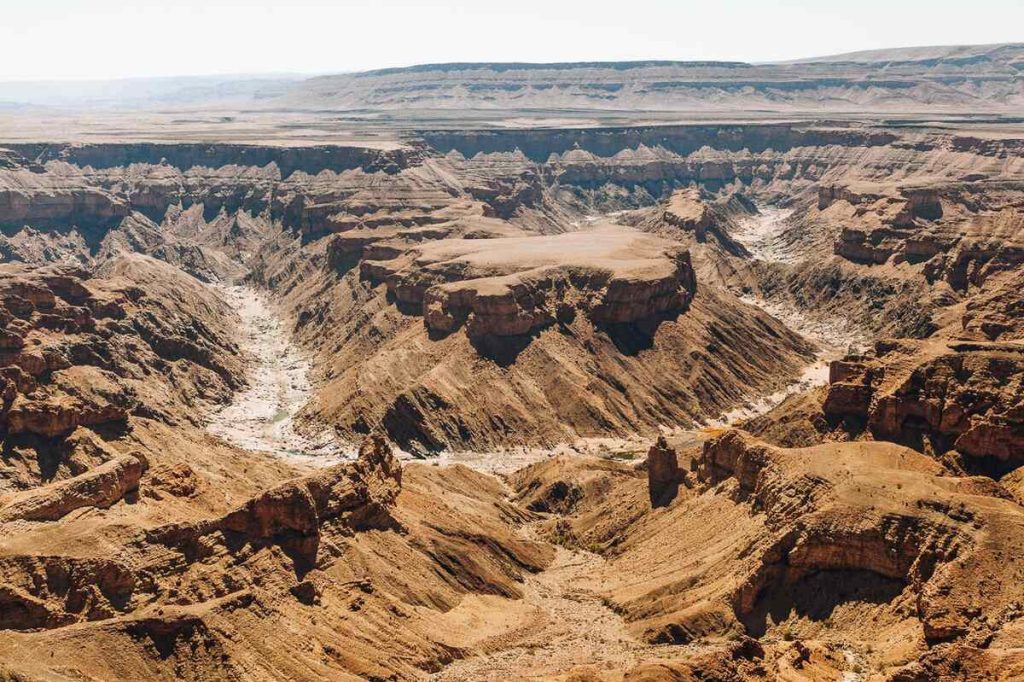
Welcome to Namibia.
Your journey begins in Windhoek, the country’s capital and the meeting point for your small group adventure.
After arrival and transfer arrangements, settle into your accommodation and allow yourself time to recover from the journey.
The first day is intentionally light.
Instead of immediately beginning a long transfer, the group has time to arrive at different times, settle in and prepare for the road ahead.
Later, meet your guide and fellow travelers.
This first gathering is an important part of a small-group journey.
Your guide can introduce:
Depending on arrival times, the evening may include a relaxed meal together.
This provides an opportunity to get to know the people who will share the next twelve days of exploration.
Overnight: Windhoek
Main Experience: Arrival, group introduction and journey briefing
After breakfast, leave Windhoek and begin the first road journey into Namibia’s open countryside.
The city gradually disappears as the group enters increasingly spacious landscapes.
Your destination is the Kalahari, where long red dunes and open plains provide an immediate introduction to Namibia’s scale.
The Kalahari creates a very different first impression from the giant dunes of Sossusvlei.
Here, vegetation grows between long parallel sand ridges.
Possible wildlife in the broader region may include:
The exact experience depends on accommodation location and local conditions.
After the drive, settle into your lodge or camp.
This first countryside evening should remain unhurried.
Enjoy the wide horizon, changing light and quiet atmosphere.
Some properties may provide locally operated nature activities, depending on the final itinerary.
The important point is to begin Namibia slowly rather than treating every day as a checklist.
Overnight: Kalahari region
Main Experience: Red dunes, open landscapes and first night outside the city
After breakfast, the journey continues west toward one of Namibia’s most famous regions—the Namib Desert.
Today’s drive demonstrates why overland travel is such an important part of experiencing the country.
The landscapes become increasingly dry and dramatic.
Mountains appear on the horizon.
Small settlements become less frequent.
The sense of scale grows.
Eventually the group reaches the wider Sesriem and Sossusvlei region, gateway to the famous dune landscapes of the Namib-Naukluft area.
Namibia Tourism describes Namib-Naukluft as one of the world’s great conservation landscapes, with Sossusvlei and Sesriem among its best-known attractions. Visit Namibia
The afternoon is best kept relatively relaxed because the following morning usually begins early.
Settle into your accommodation and watch the desert light change toward sunset.
The Namib is particularly striking in the evening when the colors of mountains and dunes deepen.
Overnight: Sesriem / Namib Desert area
Main Experience: Scenic journey into the Namib Desert
Today is one of the visual highlights of the entire tour.
Begin early to experience the desert when temperatures are cooler and the morning light transforms the dunes.
Your destination is Sossusvlei, one of Namibia’s most recognizable landscapes.
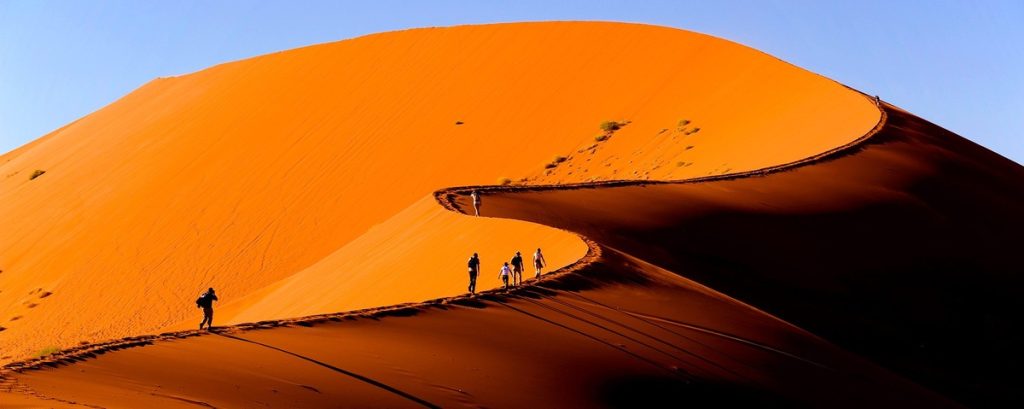
Sossusvlei is a clay-and-salt pan surrounded by enormous orange dunes.
Wind continually reshapes these dunes, creating changing lines, shadows and textures.
Namibia Tourism identifies Sossusvlei as one of the country’s major attractions and notes that the surrounding dunes are especially dramatic around sunrise and sunset. Visit Namibia
Nearby Deadvlei creates an entirely different scene.
Dark skeletal trees stand across a pale clay pan beneath towering orange dunes and deep blue sky.
The trees are remnants of an earlier wet environment before changing river conditions cut the area off from regular water. Namibia Tourism estimates some of these trees at around 900 years old. Visit Namibia
This contrast has made Deadvlei one of the most photographed landscapes in Africa.
Depending on the group’s fitness, weather and schedule, travelers may have opportunities to experience selected dunes and viewpoints.
Do not feel that the experience is only about reaching the highest point.
The desert is equally impressive from below.
Take time to notice:
Where time and local conditions permit, the day can also include Sesriem Canyon, another geological feature within the region.
Return to your accommodation later in the day.
Overnight: Namib Desert area
Main Experience: Sossusvlei, Deadvlei, giant dunes and desert photography
Sossusvlei is more than a place to photograph orange dunes.
The landscape belongs to the wider Namib Sand Sea, a UNESCO World Heritage property.
UNESCO identifies it as the world’s only coastal desert containing extensive dune fields strongly influenced by fog, and recognizes its geological, ecological and scenic importance. UNESCO World Heritage Centre
For travelers, this creates an environment that feels almost abstract.
Sand, clay, light and sky dominate the landscape.
After the greener Kalahari, the scale and dryness of Sossusvlei reveal another completely different Namibia.
After breakfast, leave the interior desert and travel toward Namibia’s Atlantic coast.
This is another highly scenic road day.
The route crosses open desert landscapes where settlements can be few and distances feel enormous.
The environment changes gradually until the cool influence of the Atlantic becomes noticeable.
Eventually, arrive in Swakopmund.
The contrast can be surprising.
After days of heat, sand and inland landscapes, Swakopmund often feels cooler because of its coastal location.
Namibia Tourism describes Swakopmund and nearby Walvis Bay as coastal centres where the sea meets the desert. Visit Namibia
Swakopmund introduces:
After several nights in remote landscapes, the town also gives the group access to a wider range of restaurants and facilities.
Enjoy a relaxed evening.
Overnight: Swakopmund
Main Experience: Scenic desert crossing and Atlantic Ocean arrival
Today provides a welcome break from long-distance travel.
The group remains around the coast, allowing travelers to choose between exploration and relaxation.
Walk through the town and notice the architectural and cultural contrasts.
The combination of desert setting and Atlantic weather gives Swakopmund a distinctive atmosphere.
Swakopmund and nearby Walvis Bay are among Namibia’s main centres for optional activities.
Namibia Tourism lists experiences in the region such as:
The exact activities can be chosen according to personal interests and the final group-tour arrangements.
This day is intentionally less structured.
A journey feels much better when travelers occasionally have time to:
That pause makes the second half of the tour more enjoyable.
Overnight: Swakopmund
Main Experience: Atlantic coast and flexible exploration
After breakfast, leave the coast and begin traveling inland toward Damaraland.
The landscape changes again.
Coastal conditions gradually give way to rocky mountains, open plains and dry river systems.
Namibia Tourism describes Damaraland as a destination of rugged mountains, grass-covered plains, cultural heritage and desert-adapted wildlife. Visit Namibia
Today should not be considered merely a transfer.
The road provides opportunities to observe Namibia’s geological scale.
Possible scenery includes:
Depending on the final routing, selected scenic stops can be made along the way.
Arrive at your lodge or camp later in the day.
Damaraland often feels dramatically quieter than Swakopmund.
That is precisely the point.
The group has moved from a coastal town back into wilderness.
Overnight: Damaraland
Main Experience: Rocky landscapes and northwestern Namibia
Today adds one of the most important cultural chapters of the tour.
Visit Twyfelfontein or /Ui-//aes, Namibia’s first UNESCO World Heritage Site.
UNESCO recognizes Twyfelfontein for one of Africa’s major concentrations of rock engravings and for the way those engravings preserve evidence of hunter-gatherer ritual traditions over at least two thousand years. UNESCO World Heritage Centre
The engravings include representations of animals such as:
Human and animal footprints also appear in the rock-art landscape. UNESCO World Heritage Centre
A guided visit helps explain that the images should not be viewed simply as ancient decoration.
They belong to a wider cultural landscape connected with movement, water, ritual activity and survival in an arid environment.
Twyfelfontein becomes particularly interesting when visitors understand the relationship between the engravings and the surrounding environment.
UNESCO specifically links the site’s ritual traditions with the importance of reliable water sources to hunter-gatherer communities. UNESCO World Heritage Centre
Depending on time and the final tour arrangement, the wider area may also provide opportunities to explore additional geological attractions.
Return to your accommodation later in the day.
Overnight: Damaraland
Main Experience: Twyfelfontein, rock engravings and cultural landscape
Damaraland provides an important transition between the coastal section and Etosha.
Swakopmund is social and coastal.
Etosha is wildlife-focused.
Damaraland sits between them as something completely different.
The region provides:
Namibia Tourism identifies the wider region with desert-adapted elephants, rhinos and lions, although these animals roam extensive landscapes and sightings should never be guaranteed. Visit Namibia
This is why Damaraland deserves its own place in a highlights itinerary rather than being treated as simply the road between Swakopmund and Etosha.
After breakfast, leave the rocky landscapes of Damaraland and travel toward Etosha National Park.
The journey gradually moves into a different ecological region.
Today marks the beginning of the main wildlife section of the tour.
Etosha is Namibia’s flagship national park and one of Africa’s notable game-viewing destinations.
Namibia Tourism records 114 mammal species and more than 400 bird species in the park. Visit Namibia
Depending on arrival time and accommodation location, the group may begin game viewing during the afternoon.
Possible wildlife includes:
Wildlife is completely natural, so no individual species can be guaranteed.
Etosha rewards patience.
Waterholes can become focal points for many different animals, especially during dry periods.
Instead of continuously driving, sometimes the best strategy is simply to wait.
One quiet waterhole can suddenly become a stage for elephants, antelope, birds and predators.
Return to camp or lodge after the first Etosha experience.
Overnight: Etosha region
Main Experience: First Etosha wildlife safari
Begin early for a complete day of wildlife viewing.
Etosha’s enormous pale pan creates a striking backdrop unlike most other safari environments.
The park’s name is associated with the pan landscape itself, historically described as a place where little vegetation grows. Visit Namibia
The cooler morning hours can provide excellent opportunities for wildlife activity.
Travel between selected routes and waterholes, searching for:
A memorable safari should not become a list of animal names.
Spend time watching:
These interactions often become stronger memories than simply seeing a rare animal for a few seconds.
The open landscape can provide excellent photographic opportunities.
Subjects include:
Return to accommodation after a full safari day.
Overnight: Etosha region
Main Experience: Full-day Etosha wildlife safari
Today provides another opportunity to explore Etosha.
This additional day is important because wildlife never repeats itself exactly.
Yesterday’s productive waterhole may be quiet today.
An area that seemed empty may suddenly provide one of the best sightings of the entire tour.
The guide can adjust the day’s focus according to previous sightings.
If elephants have been plentiful, perhaps today the group focuses more on predators.
If rhinos have been difficult to locate, additional time can be given to areas where sightings are possible.
The park has an important history of rhino conservation.
Namibia Tourism notes Etosha’s long role in black-rhino conservation and the presence of both black and white rhinos. Visit Namibia
The final Etosha afternoon should not feel like a desperate attempt to find every remaining species.
Instead, enjoy the landscape itself.
Spend longer at good sightings.
Watch how animals behave around water.
Allow the safari to finish naturally.
Overnight: Etosha region
Main Experience: Wildlife, waterholes and photography
After breakfast, leave Etosha and begin traveling south toward central Namibia.
The wildlife chapter gradually gives way to another scenic road journey.
This day is intentionally used as a transition rather than forcing the group to drive all the way to Windhoek and immediately finish the tour.
Depending on the final route and selected accommodation, the overnight location can be positioned conveniently between Etosha and the capital.
The changing scenery provides an opportunity to reflect on how dramatically the landscape has changed throughout the tour.
In less than two weeks, you have experienced:
The final countryside evening provides a quieter end before returning to Windhoek.
Overnight: Central Namibia
Main Experience: Scenic return journey and relaxed final evening
After breakfast, complete the journey toward Windhoek.
The arrival back in the capital closes the loop that began almost two weeks earlier.
Depending on onward travel arrangements, continue toward the airport or additional accommodation.
Your 13-day Namibia journey ends having moved through some of the country’s most distinctive environments.
What began as a group of individual travelers in Windhoek ends after sharing:
This shared element is one of the strongest reasons to choose a small-group tour.
Main Experience: Return to Windhoek and departure
The itinerary has been built around contrast rather than simply distance.
The red sands begin separating the traveler from the city and introduce Namibia’s extraordinary horizons.
Sossusvlei and Deadvlei introduce a much more extreme desert environment.
The wider Namib Sand Sea is globally significant; UNESCO describes it as the world’s only extensive coastal dune desert strongly influenced by fog. UNESCO World Heritage Centre
The temperature, architecture and coastal environment create a complete break from the desert interior.
Ancient rock art adds a human dimension to Namibia’s seemingly empty spaces.
Waterholes, open plains and the salt pan create the final major chapter of the journey.
That sequence gives the tour a narrative:
Space → desert → ocean → heritage → wildlife.
Namibia’s enormous scale can make independent travel feel isolating for some visitors.
A small group changes the experience.
Some of the most interesting conversations and memories develop during the drives between major destinations.
Rather than seeing a mountain, animal or archaeological site without context, travelers can understand why it matters.
Seeing an elephant approaching a waterhole or spotting a lion together becomes part of the group’s collective experience.
A well-paced small group journey does not require everyone to spend every minute together.
Swakopmund in particular provides useful time for travelers to choose their own activities and pace.
Etosha forms the principal wildlife chapter, but wildlife may be encountered elsewhere as well.
Possible sightings include:
Namibia Tourism records 114 mammal species and over 400 bird species within the park. Visit Namibia
Damaraland is associated with wildlife adapted to arid environments.
Animals roam over large territories, meaning sightings are less predictable than around Etosha’s waterholes.
The experience here is therefore more about wilderness than wildlife quantity.
Namibia can be visited during different seasons, but conditions change throughout the year.
These months generally provide cooler and drier conditions.
They are excellent for:
Early mornings can be cold, particularly in desert and safari regions.
Conditions are generally hotter and very dry.
This can be particularly rewarding for Etosha wildlife because animals may depend more heavily on remaining water sources.
Travelers should be prepared for higher daytime temperatures.
Namibia’s warmer months can bring seasonal rainfall to parts of the country.
The landscape may become greener and birdlife more active.
Rain can also create dramatic skies that photographers appreciate.
Conditions vary by region, and the coast remains influenced by the cold Atlantic even when the interior is hot.
Accommodation should reflect the landscape while maintaining a comfortable group-tour rhythm.
A comfortable hotel or lodge provides an easy arrival and departure base.
Lodges in the red-dune environment introduce guests to rural Namibia.
Accommodation near Sesriem helps make the early Sossusvlei visit practical.
A town hotel or guesthouse provides access to restaurants and optional activities.
Lodges and camps often emphasize remote landscapes and views.
Accommodation may be located inside the national park or in convenient areas near park access points depending on the final departure.
The important factors are:
This itinerary is particularly strong for travelers who enjoy photography because the subjects change almost every day.
Photograph:
Look for:
Capture:
Focus on:
Wildlife photography becomes central:
The result is not simply a wildlife album.
It becomes a photographic record of Namibia itself.
Because the journey crosses desert, coast and wildlife areas, layers are more useful than packing for only hot weather.
Bring:
Useful items include:
Consider:
Swakopmund can feel surprisingly cool.
A jacket or windbreaker is useful even when inland Namibia is hot.
Keep accessible:
Namibia’s attraction depends heavily on the condition of its landscapes.
Stay on permitted roads and walking areas where required.
Desert surfaces can be fragile and may retain damage for long periods.
At Twyfelfontein, archaeological features should never be touched or damaged.
UNESCO recognizes protection and visitor management as important to maintaining the site’s integrity. UNESCO World Heritage Centre
Animals should be viewed without pressure or disturbance.
No photograph is worth forcing wildlife to change its natural behavior.
Ask before photographing people and approach cultural encounters as opportunities for respectful learning rather than staged entertainment.
The route combines several of the country’s defining experiences without trying to include every possible destination.
A small group provides companionship without requiring travelers to organize an entire private journey.
Couples can enjoy the social aspect of group travel while still having private accommodation and personal time.
Several days around Etosha give wildlife an important place in the itinerary.
Few journeys change scenery as dramatically as this one.
From Deadvlei to Etosha, the trip provides unusually varied photographic subjects.
The combination of desert, coast, heritage and wildlife gives the trip greater depth than a wildlife-only tour.
Namibia’s distances are too large for an enjoyable highlights tour to be rushed.
Thirteen days allows the journey to develop in stages.
Windhoek and the Kalahari introduce the country’s scale.
Sossusvlei provides the major landscape experience.
Swakopmund slows the journey and changes the atmosphere.
Damaraland and Twyfelfontein provide history, geology and remoteness.
Etosha provides several days of safari before the journey returns south.
This creates a travel rhythm that makes sense:
Arrival → desert → coast → culture → wildlife → return.
Rather than filling the page with repetitive questions, travelers can use this section to imagine how their Namibia experience can become more personal.
Scenic flights are available from selected locations and can provide an extraordinary perspective over the dune landscape.
Namibia Tourism highlights flights over Sossusvlei and the Namib Desert as one of the country’s popular scenic experiences. Visit Namibia
Travelers interested in the Atlantic can consider locally operated marine activities while staying around Swakopmund.
Swakopmund is a major centre for dune-based activities, including sandboarding. Visit Namibia
Wildlife-focused travelers can extend the trip by adding another Etosha night.
Travelers interested in culture, geology and remote landscapes may prefer an additional night in the northwest.
These experiences should remain optional so the basic tour does not become over-scheduled.
For 2026–2027 departures, planning should focus on the quality of the route rather than simply securing any available accommodation.
One unavailable lodge should not force the itinerary into unnecessary backtracking.
Staying conveniently for Sossusvlei helps protect the early morning experience.
Avoid filling every hour with compulsory excursions.
Do not reduce Twyfelfontein to a rushed road stop.
Wildlife is unpredictable, so several game drives provide a much stronger experience than one afternoon.
Use:
/13-day-highlights-of-namibia-small-group-tour/
rather than including 2026-2027 in the URL.
This allows the same page to remain useful when future departure years are updated.
The 13-Day Highlights of Namibia Small Group Tour 2026–2027 is designed for travelers who want to see Namibia’s famous places but also understand how those places connect.
You begin among the open landscapes beyond Windhoek and gradually enter the red sands of the Kalahari.
Then the country becomes more dramatic.
The enormous dunes of Sossusvlei rise from the Namib Desert, while the ancient trees of Deadvlei create one of Africa’s most recognizable landscapes.
From there, the route reaches the cold Atlantic Ocean at Swakopmund, where the desert suddenly meets the coast.
The journey then turns north through the rocky wilderness of Damaraland, where the ancient engravings at Twyfelfontein reveal thousands of years of human interaction with an arid landscape.
Finally, the tour reaches Etosha National Park.
The focus shifts from landscapes and history to elephants, rhinos, lions, giraffes, antelope and the extraordinary wildlife gatherings around Etosha’s waterholes.
The complete route tells one connected story:
Windhoek → Kalahari → Sossusvlei → Swakopmund → Damaraland → Twyfelfontein → Etosha → Windhoek.
And because the journey is experienced as a small group, the memories are not only of places.
They are also of the people you travel with, the conversations between destinations, the shared excitement of wildlife sightings and the quiet moments beneath Namibia’s enormous skies.
For 2026–2027, the tour can be arranged around:
Choose your preferred 2026 or 2027 travel period and begin planning a Namibia journey that balances scenery, culture, wildlife and comfortable travel.
Additional nights can be added in Etosha, Swakopmund, Damaraland or Windhoek for travelers who prefer an even slower journey.
Travel from the towering dunes of the Namib to the wildlife waterholes of Etosha, discovering why Namibia is a country where the journey between destinations can be just as memorable as the destinations themselves.
No results available
ResetNo results available
ResetTanzania is a year-round safari destination with many adventures being offered all over the country. For optimal wildlife sightings, the dry season from June to October is your best bet! Read more on when to visit Tanzania
Both have their perks with Big Five national parks, the incredible Great Migration and that quintessential African experience we all dream of. Check out our article on Serengeti vs Masai Mara to help you decide.
They both have such different safari experiences! Tanzania offers Big Five game reserves on classic dusty desert plains, rather South Africa partners the Big Five animals with luscious winelands. Both are just as good, but it depends on your safari style.
That’s a tough one! Botswana is home to herds of elephants at Chobe and the sparkling Okavango Delta, and Tanzania has the iconic Mount Kilimanjaro and Great Migration. Check out our article on Botswana vs Tanzania safaris to help you decide.
Tanzania is in general a safe, hassle-free country. However, like most places, you do need to take precautions and listen to your tour guide. It also pays to read our articles on ‘Things to know before going to Tanzania’.
A camera and binoculars are a must. You’ll regret it if you don’t take them! As for clothing, definitely pack lightweight, breathable clothing. Remember, Tanzania is an arid country so the days can get quite hot. Read more on what to pack for a safari in Tanzania in our travel magazine
EXPERIENCES
BEST TOURS
copyright©2026 . Enjore Safaris