The 3 Days Murchison Big 5 Wildlife Safari in Uganda 2026–2027 is one of the most complete short wildlife adventures available from Kampala or Entebbe, combining rhino conservation, classic African savanna wildlife, the River Nile, Murchison Falls, big cats, elephants, giraffes, hippos, crocodiles and exceptional birdlife within a compact three-day journey.
A true short Big Five experience in this part of Uganda is best understood as a combination of Ziwa Rhino Sanctuary and Murchison Falls National Park.
The traditional Big Five are:
Lion → Leopard → Elephant → Buffalo → Rhino
Murchison Falls National Park provides opportunities to search for lion, leopard, elephant and buffalo, while the rhino component is normally experienced through a professionally managed visit to Ziwa Rhino Sanctuary on the Kampala–Murchison route.
This distinction is important because rhinos should not be marketed as a normal Murchison Falls National Park game-drive sighting. Uganda’s rhino recovery program has expanded significantly in 2026, with UWA moving southern white rhinos from Ziwa into other protected landscapes including Ajai Wildlife Reserve and Kidepo Valley National Park as part of the national restoration program. Uganda Wildlife Authority
Murchison itself remains Uganda’s largest national park at approximately 3,840 square kilometres. Uganda Wildlife Authority currently records 144 mammal species and 556 bird species, with habitats ranging from open northern savanna and Borassus-palm landscapes to woodland, riverine forest and the Victoria Nile. Uganda Wildlife Authority
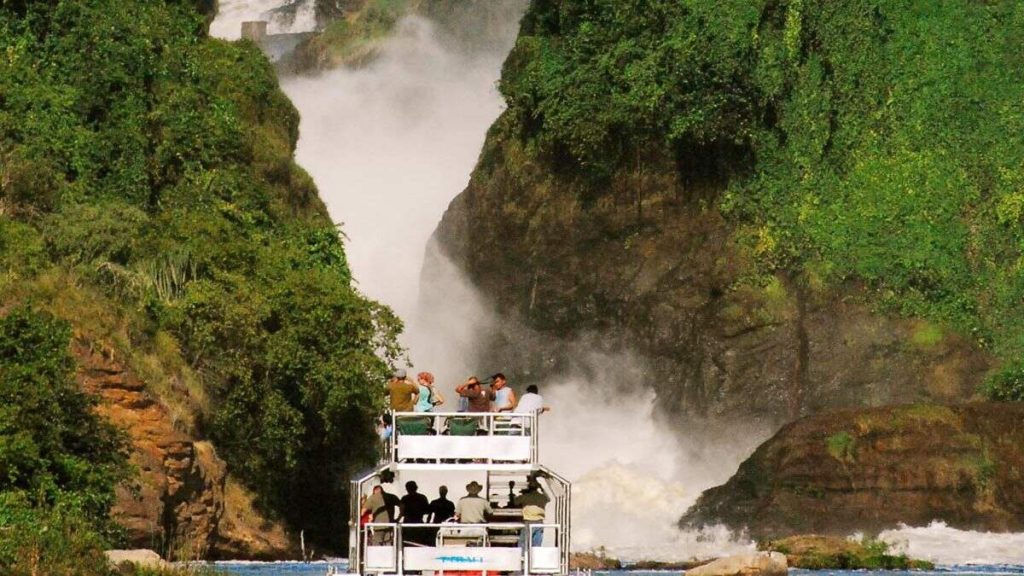
At the center of the park is the extraordinary Murchison Falls, where the Victoria Nile is compressed through a very narrow rocky gorge before plunging violently into the river below. UWA currently describes the gorge at roughly eight metres wide with a fall of about 45 metres. Uganda Wildlife Authority
The complete three-day adventure can follow:
Kampala/Entebbe → Ziwa Rhino Sanctuary → Murchison Falls National Park → Northern Savanna Game Drive → Nile Boat Safari → Murchison Falls → Kampala/Entebbe
The experience develops naturally through:
Rhino conservation → African savanna → lions and elephants → Nile wildlife → hippos and crocodiles → powerful waterfall → Uganda countryside.
For travelers visiting Uganda in 2026–2027, this route provides one of the strongest ways to experience substantial wildlife diversity without requiring a week-long itinerary.
Three days is short enough to fit into a wider Uganda or East Africa holiday but long enough to provide several completely different wildlife experiences.
Instead of simply driving into a national park, completing one game drive and returning, the itinerary combines:
This diversity makes the journey feel much larger than its three-day duration.
The safari should not imply that all five species live together within one easy game-drive circuit.
The more accurate Big Five progression is:
Ziwa Rhino Sanctuary → Rhino
followed by:
Murchison Falls National Park → Lion + Leopard possibility + Elephant + Buffalo
Even with this combination, wildlife remains natural.
Seeing every one of the Big Five cannot be guaranteed.
Leopard in particular can be extremely difficult to locate.
Murchison Falls covers approximately 3,840 km², making it Uganda’s largest national park. Uganda Wildlife Authority
That size creates room for extensive wildlife habitats and varied landscapes.
Many African safaris focus almost entirely on game drives.
Murchison provides something different.
Day 2 can combine:
Savanna wildlife in the morning
with:
Hippos, crocodiles, elephants and river scenery from the Nile in the afternoon.
The change in perspective keeps the experience fresh.
Murchison Falls National Park lies in northwestern Uganda at the northern end of the Albertine Rift Valley.
Uganda Wildlife Authority places the park approximately 305 kilometres north of Kampala, with the journey to the southern entrance generally requiring around four to five hours before allowing for stops and onward travel inside the park. Uganda Wildlife Authority
For a three-day safari, an early departure is therefore important.
The park is centered around the Victoria Nile, which divides the landscape and eventually flows toward Lake Albert.
The park combines several major attractions within one protected area.
Possible wildlife includes:
The Nile supports:
The river itself becomes the main natural attraction as it forces enormous volumes of water through the narrow gorge.
UWA currently records 556 bird species within the park. Uganda Wildlife Authority
That makes Murchison highly rewarding for travelers interested in both large mammals and birds.
The term Big Five originally referred to lion, leopard, elephant, buffalo and rhino.
For this three-day Uganda itinerary, each species has a different wildlife story.
The rhino experience is associated with Ziwa Rhino Sanctuary, rather than the standard Murchison game-drive landscape.
Uganda’s rhino conservation program began rebuilding the country’s rhino population through Ziwa after rhinos had disappeared nationally through poaching and insecurity.
UWA’s 2026 State of Wildlife report documents the major growth of the breeding program and the current expansion of rhinos into additional protected areas as part of Uganda’s long-term restoration strategy. Uganda Wildlife Authority
Murchison provides strong lion possibilities, particularly across suitable northern grassland habitats.
Leopards occur but are secretive.
Seeing one should be considered a major bonus.
Elephants are one of Murchison’s defining large mammals and may be seen on game drives as well as around the Nile.
Buffalo may be encountered in substantial herds and around river environments.
Your 3 Days Murchison Big 5 Wildlife Safari in Uganda begins early from Kampala, Entebbe or another agreed pickup point.
Meet your professional driver-guide and begin traveling north through central Uganda.
An early departure protects valuable time because Day 1 combines a substantial road journey with the rhino conservation experience and onward travel toward Murchison Falls.
The city gradually disappears behind you.
The route moves through:
The journey begins revealing a different side of Uganda from the busy Kampala–Entebbe corridor.
Continue north toward the Nakasongola District, where Ziwa Rhino Sanctuary forms one of the most important parts of Uganda’s modern wildlife-conservation story.
Uganda once supported both northern white and eastern black rhinos, but the country lost its wild rhino populations during the instability and poaching of the twentieth century.
UWA explains that Ziwa was established in 2005 as the foundation of Uganda’s southern white rhino breeding and restoration program. Uganda Wildlife Authority
The program has since become successful enough for Uganda to begin restoring rhinos to other protected landscapes.
Arrive at Ziwa for the professionally managed rhino experience.
This is not an independent wildlife walk.
The visit takes place according to sanctuary regulations and official ranger guidance.
The purpose is to observe southern white rhinos while also understanding:
The conservation story is especially relevant for 2026–2027 because Uganda is now moving beyond a single-sanctuary model.
In January 2026, UWA moved four white rhinos from Ziwa to Ajai Wildlife Reserve, and in March began another translocation program returning rhinos to Kidepo Valley National Park after more than four decades. Uganda Wildlife Authority
This means your rhino experience represents not merely a tourist attraction but part of a much larger national conservation recovery.
Southern white rhinos are enormous grazing mammals.
Possible observations may include animals:
The objective should be quiet, respectful wildlife observation.
Remain with the authorized ranger and follow sanctuary rules.
Wild animals should always determine the nature of the encounter.
The rhino experience creates the first part of your Big Five journey.
Afterward, the safari continues toward Murchison Falls, where the focus changes to:
The complete concept therefore becomes much more accurate:
Rhino at Ziwa → Four additional Big Five species within the Murchison ecosystem.
Again, this describes possibilities, not guaranteed sightings.
After the Ziwa experience, continue north according to the planned schedule.
Enjoy lunch either en route or as arranged with the safari program.
The landscape continues changing as you approach northwestern Uganda.
Eventually, you enter the wider Murchison Falls Conservation Area.
The park feels substantially different from the landscape around Kampala.
Open savanna becomes increasingly dominant in parts of the ecosystem.
Depending on your entrance route and accommodation location, the journey may reveal:
UWA describes the northern section as predominantly open savanna and acacia woodland, while southern sections contain more woodland and forest environments. Uganda Wildlife Authority
Even before the main Day 2 game drive, natural wildlife may appear.
Possible animals include:
Nothing should be guaranteed.
The journey to the lodge remains part of the safari.
Check into your selected lodge or safari camp.
Accommodation may be located:
For a short three-day safari, accommodation location matters.
A well-positioned property can reduce unnecessary morning driving and protect more time for actual wildlife viewing.
Enjoy dinner and rest.
The following day becomes the main Murchison wildlife experience.
Overnight: Murchison Falls National Park area
Main Experience: Uganda countryside, Ziwa Rhino Sanctuary, rhino conservation and arrival at Murchison Falls
Wake early for the most important wildlife day of the safari.
Day 2 combines two experiences:
Morning savanna game drive
and
Afternoon Nile boat safari.
This combination makes Murchison different from many conventional wildlife itineraries.
You experience animals from both land and water.
Begin exploring the productive savanna environments of Murchison Falls National Park.
UWA identifies the Buligi Peninsula and associated northern plains among the park’s principal game-viewing landscapes. Uganda Wildlife Authority
The open country is particularly suited to searching for:
The morning route should remain flexible according to recent animal movement and park conditions.
Lions are among the primary predator possibilities during the game drive.
Possible observations include:
Morning temperatures can provide opportunities to encounter predators before the hotter part of the day.
However, wildlife remains unpredictable.
Instead of treating a lion sighting as a quick photography stop, observe behavior when circumstances allow.
You may notice:
Longer observation often produces a stronger safari experience than constantly changing locations.
Leopard completes one of the most difficult parts of a potential Big Five checklist.
These cats are secretive and use cover extremely effectively.
Possible habitats include:
Seeing a leopard during a three-day Murchison safari should therefore be considered an exceptional bonus.
No responsible safari operator should promise it.
Elephants are among the park’s most impressive wildlife.
UWA’s current Murchison information notes substantial elephant populations within the protected landscape. Uganda Wildlife Authority
Possible encounters include:
Murchison can provide two perspectives on elephants.
In the morning, you may see them from the safari vehicle.
Later, animals may appear along the Nile during the boat journey.
Buffalo provide another Big Five opportunity.
Possible observations include:
The Nile becomes particularly important during warmer conditions because wildlife may move toward water.
One of Murchison Falls National Park’s particularly distinctive wildlife attractions is its giraffe population.
Uganda plays an important conservation role for the Nubian giraffe, and UWA reported in 2026 that conservation and translocation programs have helped the broader population recover to more than 2,500 individuals, with Uganda supporting a substantial share of them. Uganda Wildlife Authority
Possible observations include:
Their height makes them excellent subjects for wide landscape photography.
Uganda kob are among the characteristic antelope of the park’s open grasslands.
They may occur in substantial numbers.
Possible scenes include:
These herbivores form an important part of the wider predator-prey ecosystem.
Hartebeest are another characteristic large antelope of northern Uganda.
Their long faces and sloping backs make them easy to distinguish from other antelope.
They contribute to the distinctive northern-Uganda character of the game drive.
Do not focus entirely on large mammals.
Possible smaller species can add variety to the morning game drive.
Observe how animals use different habitats rather than simply trying to accumulate a species checklist.
Warthogs are common enough to be overlooked by some visitors, but they can provide entertaining observations.
Possible behavior includes:
Hyenas may also be encountered in the wider ecosystem.
They are highly capable predators as well as scavengers.
Possible observations may include:
Their ecological role is much more complex than their popular reputation suggests.
UWA currently lists 556 bird species for Murchison Falls National Park. Uganda Wildlife Authority
Possible savanna birds include:
The birdlife changes dramatically once the safari reaches the river later in the day.
After several hours of wildlife viewing, return toward the lodge or designated lunch arrangement.
Take time to rest before the afternoon boat cruise.
The shift from game vehicle to river boat creates a completely different safari atmosphere.
Travel toward the Paraa area and board the authorized boat service for the journey along the Victoria Nile toward Murchison Falls.
UWA describes the traditional upriver boat journey from Paraa toward the falls as one of the park’s oldest and most popular excursions. Uganda Wildlife Authority
The river becomes a wildlife corridor.
Instead of searching across wide grasslands, attention shifts toward the banks and water.
Hippos are among the most characteristic animals of the river experience.
Possible observations include:
The word Paraa itself is traditionally associated with “home of the hippo,” reflecting the historical importance of these animals to the area. Uganda Wildlife Authority
Large Nile crocodiles inhabit the river.
They may be observed:
Murchison’s Nile environment is one of Uganda’s most impressive places to appreciate these ancient reptiles from an authorized safari boat.
Elephants may approach the Nile for water.
This can create beautiful scenes of:
The perspective from water can make these encounters feel completely different from the morning game drive.
Buffalo may also gather near the river.
UWA’s information on Murchison specifically identifies buffalo, hippos and crocodiles among the major animals associated with the calmer Nile below the falls. Uganda Wildlife Authority
Waterbuck are well adapted to river and wetland environments.
Other mammals may also move toward the Nile during the afternoon.
The safari therefore continues even before reaching the waterfall itself.
The river attracts a remarkable diversity of birds.
Possible species include:
The river safari can be particularly rewarding for bird photographers.
The shoebill is one of Uganda’s most famous birds.
Within Murchison, the Nile Delta toward Lake Albert is especially associated with shoebill possibilities.
UWA notes that delta boat excursions can provide opportunities for this iconic species, particularly during favorable seasonal conditions. Uganda Wildlife Authority
However, the standard boat cruise toward Murchison Falls is different from a dedicated delta excursion.
A shoebill should therefore not be promised on every Murchison boat trip.
As the boat travels upriver, the scenery becomes increasingly dramatic.
The sound of the waterfall begins dominating the environment.
The Victoria Nile is gradually compressed into a much narrower rocky channel.
UWA describes the river being forced through an approximately eight-metre gorge before plunging roughly 45 metres. Uganda Wildlife Authority
This enormous concentration of water explains the extraordinary power of the falls.
The falls provide something beyond wildlife.
This is a geological and hydrological spectacle.
Upstream, the Nile is broad.
At Murchison, the water is forced through a narrow gap in the rock.
Below the falls, the river becomes calmer again as it continues toward Lake Albert.
This creates the extraordinary progression:
Broad Nile → narrow gorge → violent waterfall → calmer wildlife-rich river.
Strong subjects can include:
Use wider compositions occasionally.
A photograph of an elephant beside the Nile can tell more about Murchison than a tightly cropped elephant portrait.
After viewing the falls from the permitted boat approach, begin the return journey.
The same river may reveal completely different wildlife on the way back.
Light also changes during the afternoon.
Possible photography can include:
Return toward Paraa and continue to your accommodation.
Enjoy dinner after a complete day combining:
Savanna + Big Five search + Nile + waterfall.
Few short Uganda itineraries provide this much variation within one day.
Overnight: Murchison Falls National Park area
Main Experience: Lions, elephants, buffalo, leopard possibilities, giraffes, Nile boat cruise, hippos, crocodiles and Murchison Falls
Wake for your final morning in the Murchison ecosystem.
Depending on accommodation, road conditions and the agreed program, the final day can include additional landscape or wildlife viewing before beginning the return journey.
A particularly important final experience is appreciating Murchison Falls from the land side, which provides a completely different perspective from the Day 2 boat cruise.
From the designated viewpoint area, the river’s power becomes dramatically obvious.
The experience differs from the boat.
From below, you see the falls ahead of you.
From above, you can appreciate the way the Nile is forced into the narrow rocky gorge.
UWA lists Top of the Falls among the park’s established visitor experiences. Uganda Wildlife Authority
Follow current park guidance and remain within designated visitor areas.
The waterfall is not only visual.
Its most memorable characteristics can include:
UWA continues to identify Murchison Falls as the defining natural attraction of the national park. Uganda Wildlife Authority
Before leaving, appreciate how many completely different environments have appeared within only two nights:
This variety is one of the strongest reasons Murchison works well for a short safari.
Begin traveling south toward central Uganda.
Wildlife country gradually gives way to:
The return journey provides time to reflect on the complete Big Five route.
Continue toward your final destination.
This may be:
Because traffic can vary significantly, travelers with onward flights should leave realistic scheduling margins rather than planning an extremely tight same-day connection.
Your 3 Days Murchison Big 5 Wildlife Safari in Uganda 2026–2027 then comes to an end.
Main Experience: Murchison Falls landscape, final Uganda countryside and return journey
Potentially yes—but only when the itinerary includes the rhino experience outside the national park.
The realistic Big Five arrangement is:
Rhino → Ziwa Rhino Sanctuary
Lion → Murchison Falls National Park
Leopard → Murchison Falls National Park, but difficult
Elephant → Murchison Falls National Park
Buffalo → Murchison Falls National Park
This is a much more accurate way to market a Murchison Big Five Safari than implying rhinos are normally seen on the same park game drive.
Even with the correct itinerary, all five cannot be guaranteed.
Ziwa represents one of Uganda’s most successful conservation-recovery stories.
Uganda lost its native wild rhinos in the twentieth century.
The modern recovery effort began through carefully managed reintroduction and breeding.
UWA’s State of Wildlife Resources in Uganda 2026 reports that the Ziwa breeding population expanded dramatically from its original founder animals, creating the population base now allowing rhino restoration in other Ugandan protected areas. Uganda Wildlife Authority
Uganda’s rhino geography is now changing.
In January 2026, rhinos were reintroduced to Ajai Wildlife Reserve. Uganda Wildlife Authority
In March 2026, another national initiative began returning rhinos to Kidepo Valley National Park. Uganda Wildlife Authority
This makes 2026–2027 a particularly interesting period in Uganda’s rhino conservation story.
Lions are among the principal predator targets on a Murchison game drive.
The open northern grasslands provide important habitat for both predators and prey.
Possible lion scenes include:
The most important principle is never to guarantee a particular sighting.
Leopard may complete the Big Five list, but it is often the most difficult animal to find.
Its secretive nature means even experienced guides cannot guarantee a sighting.
A three-day safari can therefore still be excellent without leopard.
The strongest wildlife experiences should be measured by:
rather than only by completing a checklist.
Elephants can become one of the defining animals of the trip.
UWA’s current park profile notes a substantial elephant population and continued recovery. Uganda Wildlife Authority
They may be encountered:
The ability to observe them from both land and water makes Murchison particularly interesting.
Buffalo can also be encountered both inland and around the Nile.
Possible observations include:
The species forms an important part of both the Big Five story and the wider savanna ecosystem.
Although giraffes are not part of the Big Five, they can become one of the safari’s strongest attractions.
Uganda has become especially important for conservation of the Nubian giraffe.
The park’s open landscapes create excellent opportunities for observing these animals against:
For photography, the environmental setting matters as much as the animal itself.
The Nile transforms Murchison from a conventional savanna destination into something much more distinctive.
The river supports:
and eventually leads toward the extraordinary Murchison Falls.
UWA describes the calm river below the falls as especially wildlife-rich. Uganda Wildlife Authority
Hippos are strongly associated with the Victoria Nile.
A boat cruise can provide opportunities to observe them within their aquatic environment rather than only from distant shorelines.
Always follow the rules of the authorized boat operator and avoid attempting independent approaches to river wildlife.
Murchison supports impressive Nile crocodiles.
These reptiles may spend long periods almost motionless on riverbanks.
Their scale can become more obvious when viewed from the water.
Like all wildlife, they should be observed at responsible distances.
With 556 recorded bird species, Murchison is one of Uganda’s richest safari destinations for bird enthusiasts. Uganda Wildlife Authority
The combination of:
creates remarkable diversity.
Possible birds include:
A traveler who arrives interested only in elephants and lions may leave with a much greater appreciation for Uganda’s birdlife.
The shoebill is one of the country’s most sought-after birds.
Within the Murchison ecosystem, the Nile Delta toward Lake Albert provides particularly important habitat.
UWA identifies dedicated delta boat trips as one of the better Murchison options for shoebill searching. Uganda Wildlife Authority
A standard three-day itinerary may focus on the upstream waterfall cruise instead.
Travelers whose main objective is the shoebill may therefore need a customized program.
Murchison can provide wildlife experiences throughout the year.
Different seasons change the landscape significantly.
These months are generally associated with drier conditions.
Possible advantages include:
Another generally drier period.
This can be excellent for:
Heavier rainfall can produce:
Some roads may become more challenging depending on actual conditions.
Seasonal rainfall may again increase.
The park remains open, but conditions vary.
For 2026–2027 departures, actual weather should be checked closer to travel.
The dry season appeals particularly to travelers prioritizing large mammals.
Wildlife may become easier to locate around remaining water.
The landscape can also become more open.
This improves visibility in some areas.
The wetter season offers a completely different visual experience.
Possible advantages include:
A safari should not automatically be considered poor simply because it occurs outside the driest months.
A wide range of safari accommodation exists within and around the Murchison Falls ecosystem.
Suitable for travelers prioritizing wildlife over lodge luxury.
Possible characteristics include:
Often provides:
A tented property can create a stronger wilderness atmosphere while still providing private facilities.
Higher-end properties may emphasize:
For a short safari, location often matters more than elaborate luxury.
A private safari generally provides:
It can work especially well for:
A shared safari can reduce per-person transportation costs.
Travelers may share:
This style can suit:
A shared itinerary normally provides less flexibility than a private safari.
A lower-cost version can use practical accommodation and shared logistics while keeping the major wildlife experiences.
The national park remains the same.
Wild animals do not behave differently because one traveler has selected a budget lodge.
The principal difference usually comes from:
Mid-range packages provide an attractive balance between safari comfort and cost.
This can include:
It is particularly popular with first-time Uganda safari travelers.
Luxury travel can emphasize:
However, genuine safari luxury is not simply about expensive accommodation.
For a three-day wildlife trip, the greatest luxuries can be:
time + location + guiding + privacy + comfortable pacing.
Yes.
Three days provides a strong short introduction.
Kampala/Entebbe → Ziwa Rhino Sanctuary → Murchison
Morning game drive → Big Four search → afternoon Nile boat cruise
Murchison Falls → return to Kampala/Entebbe
This gives the safari a clear progression without trying to include too many distant parks.
A short itinerary becomes weaker when it tries to include too much.
Attempting something like:
Kampala → Ziwa → Murchison → Queen Elizabeth → Kampala
within three days would create excessive road travel.
For a true three-day safari, keeping the focus on Ziwa + Murchison Falls creates more actual wildlife time.
Both are outstanding Uganda safari destinations, but they provide different experiences.
Particularly strong for:
Particularly known for:
Travelers with additional days can combine both.
A longer Uganda itinerary can continue toward a chimpanzee destination such as Kibale.
This creates a powerful contrast:
Savanna wildlife → River Nile → rainforest primates.
Additional days should be allowed rather than trying to fit everything into the same three-day package.
Another longer Uganda journey can follow:
Murchison Falls → Queen Elizabeth or Kibale → Bwindi
The safari then evolves through:
This creates a much more comprehensive Uganda experience.
A wider East Africa holiday can combine:
Uganda Safari → Zanzibar
Murchison provides:
Zanzibar provides:
This works particularly well for travelers wanting wildlife first and beach time afterward.
Uganda can also form one stage of a longer East African itinerary.
Possible combinations include:
Uganda wildlife → Maasai Mara
or:
Uganda wildlife → Serengeti and Ngorongoro
The wildlife environments differ considerably, allowing travelers to experience several distinct ecosystems rather than simply repeating similar game drives.
Focus on the animal within its habitat rather than trying to force an excessively close composition.
Follow ranger directions.
Allow time for behavior when a sighting is productive.
Photograph elephants both closely and within the broader landscape.
Use the open northern plains and sky to provide environmental context.
Possible subjects include:
Use the river and rock formations to communicate the scale and force of the waterfall.
Murchison Falls is a protected natural ecosystem.
Responsible safari behavior matters.
Do not pressure the guide to move excessively close.
Quiet viewing can reduce disturbance.
Animals should remain independent of visitors.
Use permitted game-drive routes and visitor areas.
If several vehicles gather around a predator, responsible guiding should avoid creating unnecessary pressure.
Do not leave plastic or other waste behind.
Rhino tourism should be understood primarily as conservation tourism.
The sanctuary environment exists because Uganda has invested heavily in rebuilding a population that was previously lost.
Visitors should:
The objective is not simply to “tick rhino off the Big Five list.”
The encounter becomes much more meaningful when visitors understand why those rhinos are there.
The itinerary provides wildlife, landscape and conservation in one trip.
Combining Ziwa and Murchison creates realistic opportunities for all five.
A private safari provides flexibility and privacy.
A private vehicle and suitable accommodation can make the itinerary more comfortable.
Small groups can share the experience and transport costs.
Group departures may help reduce costs.
With hundreds of recorded bird species, the park provides substantial birding value.
The combination of savanna, Nile and waterfall produces excellent variety.
Is Murchison Falls National Park a Big Five destination? Murchison itself offers opportunities for lion, leopard, elephant and buffalo. A complete short Big Five itinerary traditionally adds a managed rhino experience at Ziwa Rhino Sanctuary rather than claiming that rhinos are normally part of the Murchison game-drive circuit.
Where can I see rhinos on this 3-day safari? The itinerary can include Ziwa Rhino Sanctuary in Nakasongola on the road between Kampala and Murchison. Uganda’s rhino program is currently expanding into other protected areas as part of the national restoration strategy. Uganda Wildlife Authority
Can I see all Big Five in three days? It is possible to search for all five through the combined Ziwa and Murchison itinerary, but no wildlife sighting can be guaranteed. Leopard is usually one of the most difficult species to locate.
Does Murchison have lions? Yes. Lions are among the park’s major predators and can be searched for during northern-sector game drives.
Does Murchison have leopards? Leopards occur within the ecosystem, but they are secretive and sightings are unpredictable.
Can I see elephants in Murchison Falls? Yes. Elephants are major mammals within the park and may be encountered during game drives and around the Nile. UWA’s current park profile reports a growing elephant population. Uganda Wildlife Authority
Can I see buffalo? Yes. Buffalo occur across suitable park habitats and may also be observed near the river.
Are rhinos found in Murchison Falls National Park? A standard Murchison safari should not advertise rhino as a normal game-drive sighting. Uganda’s current rhino restoration program has recently expanded rhino populations into Ajai and Kidepo, while Ziwa remains central to the national recovery story. Uganda Wildlife Authority
How large is Murchison Falls National Park? Uganda Wildlife Authority currently records the park at approximately 3,840 square kilometres. Uganda Wildlife Authority
Is Murchison Uganda’s largest national park? Yes. UWA describes Murchison Falls as Uganda’s largest national park. Uganda Wildlife Authority
How far is Murchison Falls from Kampala? UWA places the park approximately 305 km north of Kampala and estimates around four to five hours to the southern entrance before additional travel within the park. Uganda Wildlife Authority
What animals can I see during the safari? Possible wildlife includes lions, leopards, elephants, buffalo, giraffes, hippos, crocodiles, Uganda kob, hartebeest, waterbuck, warthogs, hyenas and numerous birds.
Can I see giraffes in Murchison? Yes. Giraffes are among the park’s characteristic large mammals, and Uganda plays an important conservation role for the Nubian giraffe.
Can I see hippos? Yes. Hippos are a major feature of the Victoria Nile boat safari.
Can I see Nile crocodiles? Yes. Nile crocodiles inhabit the river below Murchison Falls.
How many bird species are found in Murchison? UWA currently records 556 bird species in Murchison Falls National Park. Uganda Wildlife Authority
Can I see a shoebill? Shoebills can occur in the wider Murchison ecosystem, particularly around the Nile Delta toward Lake Albert. A dedicated delta excursion generally provides a more targeted opportunity than the standard waterfall boat cruise. Uganda Wildlife Authority
What happens on the Nile boat cruise? The authorized river excursion travels through wildlife-rich sections of the Nile toward Murchison Falls, with possibilities for hippos, crocodiles, elephants, buffalo and numerous birds. Uganda Wildlife Authority
How powerful is Murchison Falls? UWA describes the Victoria Nile being compressed through an approximately eight-metre-wide gorge before dropping about 45 metres. Uganda Wildlife Authority
Can I see Murchison Falls from both the river and land? Yes. The boat cruise provides a lower-river perspective, while designated land viewpoints near the top of the falls provide another view of the Nile entering the narrow gorge.
Is Murchison suitable for first-time safari travelers? Yes. The combination of savanna wildlife, Nile boat safari and waterfall makes it a particularly varied introduction to Uganda.
Is three days enough for Murchison Falls? Yes. Three days can provide Ziwa rhino conservation, a Murchison game drive, Nile boat cruise, waterfall viewing and road transfers from Kampala or Entebbe.
Is two days enough? It is possible to create a shorter journey, but three days provides considerably more breathing room and wildlife time.
Is the safari suitable for couples? Yes. A private three-day safari can provide comfortable flexibility and privacy.
Is the safari suitable for families? Yes. Accommodation and vehicle arrangements can be selected according to family requirements.
Can solo travelers join? Group-joining arrangements may be available, while private trips can also be organized.
Can the safari be done on a budget? Yes. Practical accommodation and shared transportation can reduce costs.
Can I choose a mid-range safari? Yes. Mid-range lodges can provide comfortable accommodation while keeping wildlife as the main focus.
Can I arrange a luxury Murchison safari? Yes. Higher-end lodges, private vehicles and premium service can be selected according to availability.
What is the best time to visit Murchison Falls? The park is a year-round destination. Drier months can provide easier large-mammal viewing, while wetter periods bring greener scenery and strong birdlife.
Is June to September good for Murchison? Yes. These months generally fall within one of Uganda’s drier periods and can provide strong safari conditions.
Is December to February good? Yes. This is another generally drier period suitable for game viewing.
Can I visit in the rainy season? Yes. Rain creates green landscapes and attractive photography, though it can affect some road and game-drive conditions.
What should I bring on the safari? Lightweight clothing, a warm layer for early game drives, sun protection, binoculars, camera equipment, personal medication, travel documents and rain protection during wetter periods can be useful.
Do I need binoculars? Binoculars are highly recommended for birds, distant predators and wildlife across open savanna.
Can Murchison be combined with gorilla trekking? Yes. A longer Uganda itinerary can continue toward Bwindi Impenetrable National Park.
Can Murchison be combined with chimpanzee trekking? Yes. Additional days can connect Murchison with one of Uganda’s forest-primate destinations.
Can Murchison be combined with Queen Elizabeth National Park? Yes, but sufficient additional travel days should be allowed.
Can I combine the safari with Zanzibar? Yes. A wider East African holiday can pair Uganda wildlife with a later Zanzibar beach stay.
Is wildlife guaranteed? No. Every animal moves naturally within its environment, so exact sightings and behavior cannot be guaranteed.
The itinerary succeeds because each day has a different identity.
Day 1 becomes:
Kampala/Entebbe → Ziwa → rhinos → conservation → Murchison wilderness.
Day 2 becomes:
Savanna → lions → elephants → buffalo → giraffes → Nile → hippos → crocodiles → Murchison Falls.
Day 3 becomes:
Waterfall landscape → final national-park scenery → Uganda countryside → Kampala/Entebbe.
The experience is not simply three consecutive game drives.
It combines land, river, conservation and landscape.
That diversity is what makes Murchison particularly suitable for a short Uganda safari.
Before confirming the trip, consider:
Uganda Wildlife Authority has also indicated tariff changes for the 2026–2027 period, so any final quotation should use the rates applying to the exact travel dates rather than automatically relying on older park-fee schedules. Uganda Wildlife Authority
The 3 Days Murchison Big 5 Wildlife Safari in Uganda 2026–2027 combines several of the country’s greatest wildlife experiences into one carefully structured short journey.
Leave Kampala or Entebbe and travel north toward Nakasongola.
The first wildlife chapter begins with Uganda’s rhino conservation story.
At Ziwa Rhino Sanctuary, experience southern white rhinos under professional ranger management while learning how Uganda rebuilt a species population that had once disappeared from the country.
Then continue into Murchison Falls National Park.
The following morning belongs to the savanna.
Search the open plains for lions.
Watch elephant families move through the landscape.
Look for buffalo herds and graceful Nubian giraffes.
Remain patient for the elusive leopard.
Then change perspective completely.
Board an authorized safari boat and travel along the Victoria Nile, where hippos occupy the water, crocodiles rest along the banks, birds fill the river environment and elephants or buffalo may appear at the water’s edge.
Ahead, the Nile becomes louder.
The river narrows.
Eventually, you reach the dramatic landscape of Murchison Falls, where the enormous flow of the Victoria Nile is compressed through a narrow rocky gorge before plunging into the river below. Uganda Wildlife Authority
After a second night in the wilderness, experience the waterfall from the land side before beginning the journey back toward central Uganda.
The complete adventure follows:
Kampala/Entebbe → Ziwa Rhino Sanctuary → Murchison Falls National Park → Big Five Search → Nile Boat Safari → Murchison Falls → Kampala/Entebbe
For 2026–2027, the journey can be customized according to:
Share your preferred travel dates, number of travelers and accommodation category to build a realistic Uganda safari around current wildlife arrangements and park regulations.
The journey can remain a focused three-day Murchison experience or expand into a longer itinerary combining Murchison Falls, chimpanzees, Queen Elizabeth National Park and Bwindi gorillas.
Begin with Uganda’s remarkable rhino-conservation recovery, continue into the savannas of Murchison in search of lions, elephants, buffalo and the elusive leopard, then finish beside the mighty Victoria Nile and the thunder of Murchison Falls on one of Uganda’s most varied short wildlife adventures.
No results available
ResetNo results available
ResetTanzania is a year-round safari destination with many adventures being offered all over the country. For optimal wildlife sightings, the dry season from June to October is your best bet! Read more on when to visit Tanzania
Both have their perks with Big Five national parks, the incredible Great Migration and that quintessential African experience we all dream of. Check out our article on Serengeti vs Masai Mara to help you decide.
They both have such different safari experiences! Tanzania offers Big Five game reserves on classic dusty desert plains, rather South Africa partners the Big Five animals with luscious winelands. Both are just as good, but it depends on your safari style.
That’s a tough one! Botswana is home to herds of elephants at Chobe and the sparkling Okavango Delta, and Tanzania has the iconic Mount Kilimanjaro and Great Migration. Check out our article on Botswana vs Tanzania safaris to help you decide.
Tanzania is in general a safe, hassle-free country. However, like most places, you do need to take precautions and listen to your tour guide. It also pays to read our articles on ‘Things to know before going to Tanzania’.
A camera and binoculars are a must. You’ll regret it if you don’t take them! As for clothing, definitely pack lightweight, breathable clothing. Remember, Tanzania is an arid country so the days can get quite hot. Read more on what to pack for a safari in Tanzania in our travel magazine
EXPERIENCES
BEST TOURS
copyright©2026 . Enjore Safaris