
The 10-Day Zimbabwe Heritage and Wildlife Tour is designed for travelers who want to understand Zimbabwe rather than simply pass through its national parks.
This journey brings together the country’s ancient stone civilizations, archaeological sites, sacred landscapes, wildlife reserves and one of Africa’s most remarkable natural landmarks.
The route begins in Harare before moving south toward Great Zimbabwe, the monumental stone settlement that gave the modern country its name. From there, the journey continues toward Bulawayo and Khami Ruins, another important archaeological site that helps explain how political and trading centers developed after Great Zimbabwe.
The cultural story then expands into the Matobo Hills, where dramatic granite formations, ancient rock paintings, sacred traditions and wildlife exist within the same landscape.
From Matobo, the focus gradually moves from cultural heritage toward wilderness as the journey continues to Hwange National Park, Zimbabwe’s largest national park and one of its most important wildlife areas. Hwange covers approximately 14,650 square kilometres and supports elephants, lions, leopards, buffalo, African wild dogs and a wide variety of other mammals and birds. ZimParks
The final destination is Victoria Falls, where the Zambezi River drops through a series of basalt gorges along the Zimbabwe–Zambia border. UNESCO recognizes Mosi-oa-Tunya/Victoria Falls as a World Heritage Site because of its exceptional natural beauty and geological significance. UNESCO World Heritage Centre
Rather than presenting heritage and wildlife as separate subjects, this itinerary connects them.
You move through Zimbabwe as a sequence of landscapes:
Ancient city → historic trading centre → sacred cultural landscape → wildlife wilderness → Victoria Falls.
That progression gives the ten-day journey a clear identity and makes it particularly suitable for travelers interested in both history and safari experiences.
Many Zimbabwe itineraries concentrate almost entirely on wildlife or Victoria Falls.
This route takes a broader approach.
It presents Zimbabwe as a country shaped by ancient civilizations, regional trade, sacred landscapes, conservation areas and natural systems.
At Great Zimbabwe, travelers encounter evidence of a major Shona civilization that flourished between roughly the 11th and 15th centuries.
The route then continues to Khami, which developed after Great Zimbabwe declined and became associated with the Torwa dynasty.
UNESCO identifies both sites as important evidence for understanding the historical development of Zimbabwe’s stone-building traditions and long-distance trade networks. UNESCO World Heritage Centre
Matobo is not simply an archaeological site.
Its granite hills contain ancient rock art, sacred places and traditions that continue to hold significance for local communities.
UNESCO notes that the Matobo Hills contain one of southern Africa’s highest concentrations of rock art and demonstrate a remarkably long relationship between people and the landscape. UNESCO World Heritage Centre
Hwange is not treated as a quick stop.
Several days are allocated to the park so travelers have time to experience different wildlife areas rather than completing one short drive and continuing immediately to the next destination.
Victoria Falls provides a natural conclusion.
After exploring human history and wildlife landscapes, the journey ends beside the Zambezi River at one of southern Africa’s most dramatic natural sites.
The route has been arranged geographically to reduce unnecessary backtracking while maintaining a clear narrative.
The journey follows:
Harare → Masvingo and Great Zimbabwe → Bulawayo and Khami Ruins → Matobo Hills → Hwange National Park → Victoria Falls
Each destination introduces a different part of the country’s story.
Harare provides the arrival point and an introduction to modern Zimbabwe.
Great Zimbabwe represents the ancient political, architectural and trading history of the region.
Khami helps continue that historical story into a later period following the decline of Great Zimbabwe.
Matobo connects archaeology, rock art, traditional spiritual significance, geology and wildlife.
Hwange shifts the journey toward Zimbabwe’s great wildlife landscapes.
Victoria Falls completes the route with natural heritage and the Zambezi River.
Welcome to Zimbabwe.
Your journey begins in Harare, the country’s capital and one of the main international arrival points.
After completing airport procedures, meet your driver or representative for the transfer to your accommodation.
The first day should remain relatively relaxed.
Instead of immediately beginning a long transfer, this allows you to recover from your journey and prepare for the days ahead.
Depending on your arrival time, you may have an opportunity to see parts of Harare or simply relax at the hotel.
A short orientation can introduce the structure of the tour and explain how the itinerary connects Zimbabwe’s heritage sites with its wildlife destinations.
The evening provides time to prepare cameras, travel documents and comfortable clothing for the following day’s journey south.
Overnight: Harare
Main Experience: Arrival and introduction to Zimbabwe
After breakfast, begin traveling south toward Masvingo, the gateway to Great Zimbabwe.
The changing landscape provides your first opportunity to see Zimbabwe beyond the capital.
On arrival in the Masvingo area, continue toward Great Zimbabwe National Monument.
This is one of the most important archaeological sites in sub-Saharan Africa.
Great Zimbabwe was built and occupied principally between approximately 1100 and 1450 and became an important political and trading centre. Archaeological discoveries at the site—including imported beads, ceramics and coins—provide evidence of connections with distant trading networks. UNESCO World Heritage Centre
The monument contains several major areas.
The Hill Complex occupies elevated granite terrain and represents one of the oldest areas of settlement within the site.
Its position provides a different perspective over the surrounding landscape.
Walking through the ruins allows visitors to consider how architecture was integrated into natural rock formations.
The Great Enclosure is among the most recognizable structures at Great Zimbabwe.
Its massive dry-stone walls demonstrate sophisticated building techniques developed without mortar.
The scale of the stonework gives visitors a clear sense of the organizational and architectural capabilities of the society that created the settlement.
The Valley Ruins help illustrate how different parts of the settlement were distributed beyond the main monumental structures.
Together, these areas make Great Zimbabwe much more than a single ruin.
They represent an extensive cultural landscape.
UNESCO inscribed Great Zimbabwe on the World Heritage List in 1986. UNESCO World Heritage Centre
After the guided visit, return to your accommodation around Masvingo.
Overnight: Masvingo / Great Zimbabwe area
Main Experience: Great Zimbabwe National Monument
Begin the morning with additional time around the Great Zimbabwe area if required before continuing west toward Bulawayo.
This travel day is important because the journey is now moving from the Great Zimbabwe period toward later political and cultural developments in southwestern Zimbabwe.
Bulawayo is the country’s second-largest city and provides the main base for exploring both Khami Ruins and the Matobo Hills.
After arrival, check into your accommodation and enjoy a slower afternoon.
Depending on timing and personal interests, the remainder of the day can be used for a short introduction to Bulawayo.
Rather than filling every hour with activities, this lighter afternoon creates a natural break between two important heritage regions.
Overnight: Bulawayo
Main Experience: Journey into southwestern Zimbabwe
After breakfast, travel to Khami Ruins National Monument, located approximately 22 kilometres west of Bulawayo.
Khami provides an important continuation of the story introduced at Great Zimbabwe.
The settlement developed after Great Zimbabwe’s decline and became the capital of the Torwa dynasty. UNESCO notes that archaeological finds from places as distant as Europe and China provide evidence of Khami’s involvement in long-distance trade. UNESCO World Heritage Centre
Khami’s architecture differs in important ways from Great Zimbabwe.
Visitors can see:
Rather than viewing Khami as simply a smaller version of Great Zimbabwe, it is better understood as another stage in the development of stone-built societies in the region.
UNESCO identifies the site as important for understanding the historical transition from Great Zimbabwe toward later Zimbabwean states. UNESCO World Heritage Centre
The architecture provides clues about social organization, political authority and regional trade.
Decorative stone patterns and terraced structures help distinguish Khami from earlier building traditions.
The archaeological evidence also demonstrates that communities in this part of Africa participated in complex regional and international trading networks.
After exploring Khami, return toward Bulawayo.
The remainder of the day may be used for additional cultural or historical exploration depending on the final tour arrangement.
Overnight: Bulawayo
Main Experience: Khami Ruins and Zimbabwean heritage
Today the journey moves south of Bulawayo into the remarkable Matobo Hills.
The landscape changes dramatically.
Large granite boulders and balancing rock formations dominate the area, creating one of Zimbabwe’s most distinctive environments.
UNESCO describes the Matobo Hills as a cultural landscape shaped by an exceptionally long relationship between people and the environment. The region contains one of the highest concentrations of rock art in southern Africa. UNESCO World Heritage Centre
Rock shelters throughout Matobo contain paintings that provide evidence of communities who lived in and interacted with this landscape over thousands of years.
A guided visit allows travelers to understand the paintings within their archaeological and environmental context rather than viewing them simply as decoration.
The value of Matobo lies partly in how human history remains embedded within the landscape itself.
Matobo continues to hold spiritual importance for communities in the region.
UNESCO specifically recognizes the continuing relationship between sacred places, religious traditions and the physical environment. UNESCO World Heritage Centre
This means Matobo should be approached respectfully as a living cultural landscape rather than only as a historical attraction.
The area also provides wildlife experiences.
Zimbabwe Parks identifies Matobo National Park as one of the country’s intensive rhino protection zones and records both black and white rhinos within the park. ZimParks
Other wildlife can include:
The combination of geology, cultural heritage and wildlife makes Matobo one of the most intellectually interesting stops on the entire journey.
Return to your accommodation after the day’s exploration.
Overnight: Bulawayo or Matobo area
Main Experience: Rock art, cultural landscape and wildlife
After breakfast, leave the Matobo/Bulawayo region and travel north toward Hwange National Park.
The character of the journey now changes.
The first half of the tour has focused strongly on archaeology and cultural landscapes.
From this point onward, wildlife and conservation become more prominent.
Hwange National Park covers approximately 14,650 square kilometres, making it Zimbabwe’s largest national park. ZimParks
After reaching the park or surrounding safari area, check into your accommodation.
Depending on arrival time, enjoy an afternoon game drive.
The first drive provides an introduction to Hwange’s woodland and savanna environments.
Possible sightings include:
Hwange is particularly associated with large elephant populations.
Zimbabwe Parks also identifies the park as an important stronghold for African wild dogs. ZimParks
As evening approaches, return to camp or lodge.
Overnight: Hwange National Park area
Main Experience: First Hwange wildlife safari
Begin early for a full day of wildlife exploration.
A major advantage of spending several nights in Hwange is that the safari does not need to become a race between sightings.
Wildlife movements change constantly.
A waterhole that appears quiet one afternoon may be extremely active the following morning.
Early hours can provide opportunities to search for predators and other animals while temperatures remain relatively cool.
Possible sightings include:
Zimbabwe Parks records approximately 100 mammal species and nearly 400 bird species in Hwange. ZimParks
Water plays an important role in Hwange’s ecosystem.
During dry periods, waterholes can become important gathering areas for wildlife.
Elephants, buffalo, antelopes and predators may all use these areas at different times.
Waiting patiently near productive water sources can often be more rewarding than constantly moving.
After a midday break, continue exploring another section of the park.
The softer afternoon light provides excellent photography conditions.
Instead of focusing only on finding famous animals, pay attention to behavior.
Watching elephants communicate, predators observe prey or birds interact around water can provide a deeper safari experience than simply creating a species checklist.
Overnight: Hwange National Park area
Main Experience: Full-day wildlife safari
A second complete day in Hwange provides time to slow the safari down further.
By now, your guide will have a clearer understanding of your interests.
The day can therefore focus on particular species, photography or habitats.
Hwange supports several major predators, including:
Predator sightings remain unpredictable, which makes additional time valuable.
Elephants are one of Hwange’s defining wildlife experiences.
Observing family groups around water can reveal complex social behavior.
Rather than simply counting how many elephants you see, watch how they interact.
Young elephants remain close to adults.
Family members communicate through movement, sound and physical contact.
Hwange also provides excellent birding opportunities.
The park’s varied woodland and savanna habitats support a large number of species, making binoculars useful even for travelers whose main interest is mammals.
The final afternoon in Hwange should feel unhurried.
This is an opportunity to appreciate the environment itself:
Return to your accommodation for your final night in the Hwange region.
Overnight: Hwange National Park area
Main Experience: Wildlife, photography and deeper safari exploration
After breakfast, leave Hwange and continue toward Victoria Falls.
Zimbabwe Parks places Hwange’s Main Camp roughly 170 kilometres by road from Victoria Falls before the final access road into the park, making the two destinations a natural combination within a northern Zimbabwe itinerary. ZimParks
On arrival, check into your accommodation before visiting the falls.
Victoria Falls is known locally as Mosi-oa-Tunya, commonly translated as “The Smoke that Thunders.”
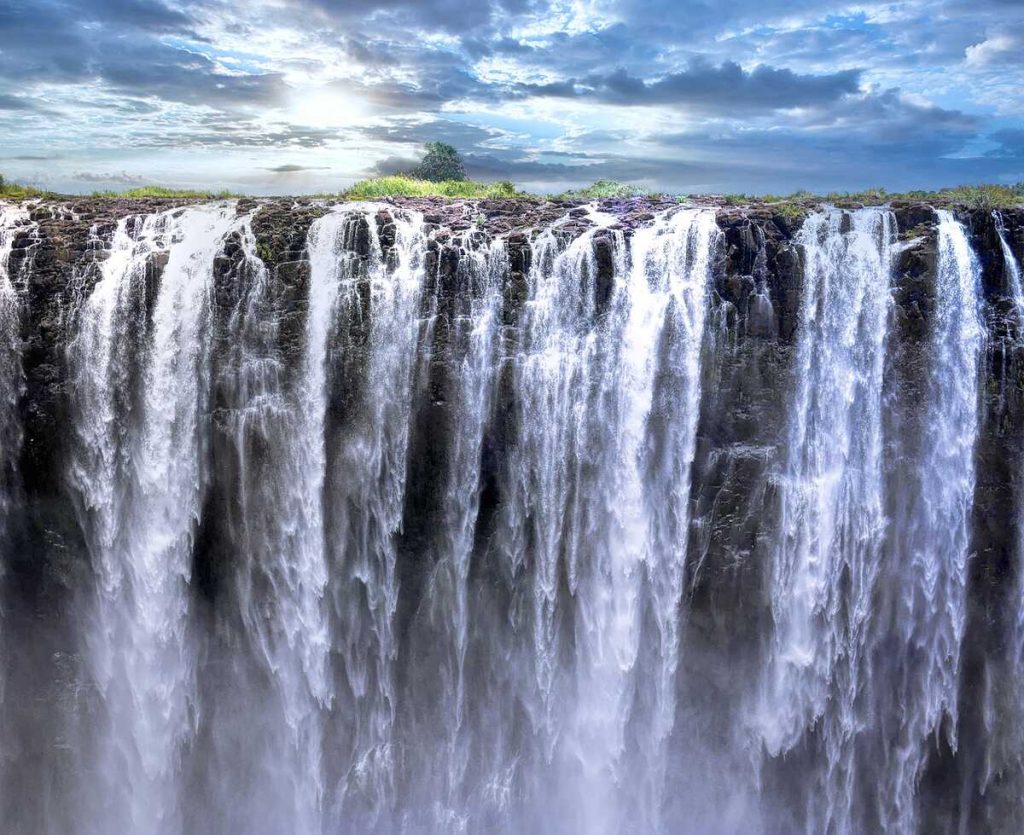
The waterfall forms where the Zambezi River plunges into a series of narrow basalt gorges.
UNESCO records the falls at approximately 1,708 metres wide, with the deepest sections reaching around 108 metres. UNESCO World Heritage Centre
The scale of the waterfall changes dramatically with the seasonal flow of the Zambezi.
At higher water levels, enormous volumes of spray rise above the gorge.
At lower levels, more of the underlying rock formations and individual sections of the falls may become visible.
Follow the established paths and viewpoints on the Zimbabwean side.
The spray from the waterfall supports a distinctive rainforest environment containing ferns, palms and other moisture-dependent vegetation. Zimbabwe Parks notes that the local forest is continually influenced by spray from the falls. ZimParks
Take time at the viewpoints rather than rushing from one to another.
The experience is not only about photographing the waterfall.
Listen to the sound, observe the mist and notice how the gorge and vegetation form part of the same landscape.
Later, return to your accommodation for the final evening of the tour.
Overnight: Victoria Falls
Main Experience: Victoria Falls World Heritage Site
Enjoy your final morning in Zimbabwe.
Depending on departure time, the morning can remain relaxed or provide additional time around Victoria Falls town.
This is also a good opportunity to reflect on how dramatically the landscapes have changed throughout the journey.
In ten days, you have moved through:
Transfer to Victoria Falls International Airport for your onward flight.
The tour ends with a much broader understanding of Zimbabwe than a conventional wildlife-only itinerary can provide.
Main Experience: Departure
The strongest feature of this itinerary is the relationship between the heritage sites.
They should not be treated as unrelated tourist attractions.
Great Zimbabwe provides the starting point.
It developed into a major centre of political and economic power and was connected to long-distance trading systems.
Its architecture remains among the most significant examples of dry-stone construction in sub-Saharan Africa. UNESCO recognizes the site as a unique testimony to Shona civilization between the 11th and 15th centuries. UNESCO World Heritage Centre
Khami represents a later chapter.
Following Great Zimbabwe’s decline, new political centres developed.
Khami became the capital of the Torwa dynasty and retained elements of earlier stone-building traditions while developing its own architectural features. UNESCO World Heritage Centre
Matobo extends the story much further back in time.
Its archaeological evidence and rock art demonstrate a long history of human interaction with the landscape.
The area also remains culturally and spiritually meaningful in the present. UNESCO World Heritage Centre
This sequence helps the traveler understand Zimbabwean heritage as continuous and layered, not limited to a single archaeological monument.
The wildlife element becomes strongest during the second half of the journey.
Matobo introduces wildlife within a cultural landscape.
The park is especially important for rhino conservation and is one of Zimbabwe Parks’ intensive rhino protection areas. ZimParks
Hwange provides the main safari experience.
Its size allows several days of exploration.
Potential wildlife includes:
Zimbabwe Parks describes Hwange as supporting 100 mammal species and nearly 400 bird species. ZimParks
Wildlife sightings are natural and should never be guaranteed.
Zimbabwe can be visited at different times of year, but the experience changes with the seasons.
These months generally bring cooler and drier conditions.
They can work particularly well for a combined heritage and safari itinerary because walking around archaeological sites is often more comfortable than during the hottest months.
Wildlife viewing also begins benefiting from increasingly dry conditions.
Early mornings can become cold, particularly on safari.
These months are often hot and increasingly dry.
Wildlife may concentrate more strongly around available water sources.
This can be highly rewarding in Hwange, but travelers should be prepared for significant daytime heat.
This period generally brings summer rains and greener landscapes.
Hwange’s rainfall is concentrated heavily around the summer season, particularly December through February. ZimParks
Green-season travel can provide:
However, rain can influence road conditions and some wildlife movements.
The appearance of Victoria Falls also changes throughout the year because the Zambezi’s water level varies seasonally.
High water creates intense spray and dramatic flow.
Lower water can provide clearer views into sections of the gorge.
Therefore, there is no single month that provides the same experience for every traveler.
Accommodation should follow the rhythm of the itinerary.
The aim is to remain comfortable without making the hotels more important than the destinations themselves.
A comfortable city hotel or guesthouse works well for the arrival night.
Choose accommodation with convenient access to the archaeological site.
This allows more time for exploration and less unnecessary driving.
A city hotel, lodge or property closer to Matobo can be selected depending on the desired balance between urban convenience and landscape experience.
Accommodation location becomes particularly important here.
Possible options range from practical safari lodges and camps to premium wilderness properties.
Visitors should consider:
Victoria Falls provides the widest range of accommodation styles on the route.
Travelers can choose from simple guesthouses to high-end hotels depending on budget.
A route like this works best when transportation is planned around the geography rather than trying to cover too many distant destinations.
The itinerary primarily follows an overland progression from eastern/central Zimbabwe toward the west and northwest.
This makes the route easier to understand and avoids repeatedly returning to the same regions.
Road travel also allows visitors to observe changes in:
For travelers wanting to reduce driving, selected domestic flights can sometimes be considered depending on current schedules and budget.
This itinerary is particularly suitable for travelers who want historical context rather than only sightseeing.
Several days in Hwange provide a substantial safari component.
The route introduces several of the country’s most important cultural and natural destinations within one journey.
The itinerary combines active exploration with quieter evenings and can be customized according to accommodation preferences.
Families interested in archaeology, wildlife and geography can find the route educational as well as adventurous.
The tour provides unusually varied photographic subjects:
Zimbabwe currently has five properties on UNESCO’s World Heritage List: three cultural properties and two natural properties. This particular route encounters Great Zimbabwe, Khami, Matobo Hills and Victoria Falls, offering an unusually concentrated heritage journey. UNESCO World Heritage Centre
Because this itinerary combines archaeological walking, road travel and wildlife safari, packing should be versatile.
Bring:
Useful items include:
Bring:
Keep important items accessible:
Avoid excessively heavy luggage if your wider travel arrangements include small domestic aircraft.
A combined heritage and wildlife journey requires respect for both cultural places and natural environments.
Do not climb on fragile structures unless access is specifically permitted.
Stone walls and archaeological surfaces can be damaged by repeated physical pressure.
Some locations within Matobo continue to have cultural and spiritual importance.
Follow local guide instructions regarding behavior, photography and access.
Keep appropriate distances and follow park regulations.
Never attempt to feed or attract wild animals.
Professional guides provide both safety and interpretation.
A good guide helps visitors understand why a site matters rather than simply showing where it is.
Ten days allows the journey to develop naturally.
A shorter itinerary would require removing major heritage sites or rushing through the wildlife experience.
With ten days, the route has distinct stages.
Harare and Great Zimbabwe introduce the country’s cultural and historical context.
Khami and Matobo deepen the heritage story.
Hwange provides several days focused on animals and ecology.
Victoria Falls provides a visually powerful conclusion.
This creates a more coherent journey than visiting disconnected attractions simply because they are famous.
The itinerary combines Zimbabwe’s archaeological and cultural heritage with wildlife safari experiences and Victoria Falls.
The route includes Great Zimbabwe, Khami Ruins and the Matobo Hills.
Yes. Great Zimbabwe National Monument was inscribed on the UNESCO World Heritage List in 1986. UNESCO World Heritage Centre
Great Zimbabwe is famous for its monumental dry-stone architecture and its importance as a political and trading centre associated with Shona civilization between the 11th and 15th centuries. UNESCO World Heritage Centre
Khami was an important political centre that developed after the decline of Great Zimbabwe and became associated with the Torwa dynasty. It is also a UNESCO World Heritage Site. UNESCO World Heritage Centre
Matobo combines distinctive granite landscapes, ancient rock art, long-standing spiritual traditions and wildlife. UNESCO recognizes the area as a cultural landscape. UNESCO World Heritage Centre
Both black and white rhinos occur in Matobo National Park, which Zimbabwe Parks identifies as one of its intensive rhino protection zones. Sightings are never guaranteed. ZimParks
Possible sightings include elephants, lions, leopards, buffalo, African wild dogs, giraffes, zebras, sable antelope, hyenas and numerous other species. ZimParks
Zimbabwe Parks states that Hwange covers approximately 14,650 square kilometres, making it Zimbabwe’s largest national park. ZimParks
Yes. Victoria Falls forms the final major destination of the itinerary.
Yes. Mosi-oa-Tunya/Victoria Falls was inscribed on the UNESCO World Heritage List in 1989. UNESCO World Heritage Centre
No. The safari component is important, but the itinerary has been deliberately designed to give equal intellectual value to Zimbabwe’s cultural and archaeological heritage.
Yes. It provides a broad introduction to Zimbabwe by combining historical sites, landscapes, wildlife and Victoria Falls.
Yes. The number of nights in Hwange, accommodation category and cultural activities can be adjusted according to travel style and budget.
Yes. Additional Victoria Falls nights can be added for travelers who prefer a slower ending to the journey.
No results available
ResetNo results available
ResetTanzania is a year-round safari destination with many adventures being offered all over the country. For optimal wildlife sightings, the dry season from June to October is your best bet! Read more on when to visit Tanzania
Both have their perks with Big Five national parks, the incredible Great Migration and that quintessential African experience we all dream of. Check out our article on Serengeti vs Masai Mara to help you decide.
They both have such different safari experiences! Tanzania offers Big Five game reserves on classic dusty desert plains, rather South Africa partners the Big Five animals with luscious winelands. Both are just as good, but it depends on your safari style.
That’s a tough one! Botswana is home to herds of elephants at Chobe and the sparkling Okavango Delta, and Tanzania has the iconic Mount Kilimanjaro and Great Migration. Check out our article on Botswana vs Tanzania safaris to help you decide.
Tanzania is in general a safe, hassle-free country. However, like most places, you do need to take precautions and listen to your tour guide. It also pays to read our articles on ‘Things to know before going to Tanzania’.
A camera and binoculars are a must. You’ll regret it if you don’t take them! As for clothing, definitely pack lightweight, breathable clothing. Remember, Tanzania is an arid country so the days can get quite hot. Read more on what to pack for a safari in Tanzania in our travel magazine
EXPERIENCES
BEST TOURS
copyright©2026 . Enjore Safaris