The 4 Days Camping Kruger National Park – Wildlife Safari 2026-2027 is a classic South African safari designed for travelers who want several days of genuine wildlife viewing while keeping accommodation simple, affordable and close to nature inside or near one of Africa’s most famous protected areas.
Rather than rushing through Kruger on a single-day excursion, this four-day itinerary provides repeated morning and afternoon wildlife periods, increasing opportunities to search for lion, leopard, elephant, buffalo, black and white rhino, cheetah, African wild dog, giraffe, zebra, hippo, spotted hyena and numerous antelope species.
Johannesburg/Mbombela → Southern Kruger National Park → Savannah, River and Woodland Game Drives → Kruger Camping Experience → Final Morning Safari → Johannesburg/Mbombela
The experience progresses through:
South African Lowveld → Kruger wilderness → Big Five possibilities → river and savannah wildlife → African sunsets → camping nights → final morning game drive.
Kruger National Park protects nearly two million hectares of northeastern South Africa and is one of the country’s flagship conservation areas. SANParks currently lists 148 mammal species and 546 bird species, with elephants, black and white rhinos, buffalo, lions, leopards, cheetahs, wild dogs, giraffes, zebras and hippos among its remarkable wildlife diversity. Sanparks
For a four-day camping safari, the strongest strategy is not to attempt to cross the entire park. Kruger is enormous. SANParks itself advises visitors to travel slowly rather than covering excessive distances because regular stops and patient observation often produce better wildlife experiences. Sanparks
Four days gives Kruger time to reveal itself.
A one-day safari can be excellent, but wildlife is unpredictable. Lions may remain hidden in tall grass. Leopards may spend hours concealed in woodland. Elephants may move away from a particular road, while wild dogs can travel considerable distances.
Several days provide multiple chances.
A typical four-day safari includes an arrival-day game drive, two substantial wildlife days and a final morning safari before departure.
Camping also changes the character of the trip.
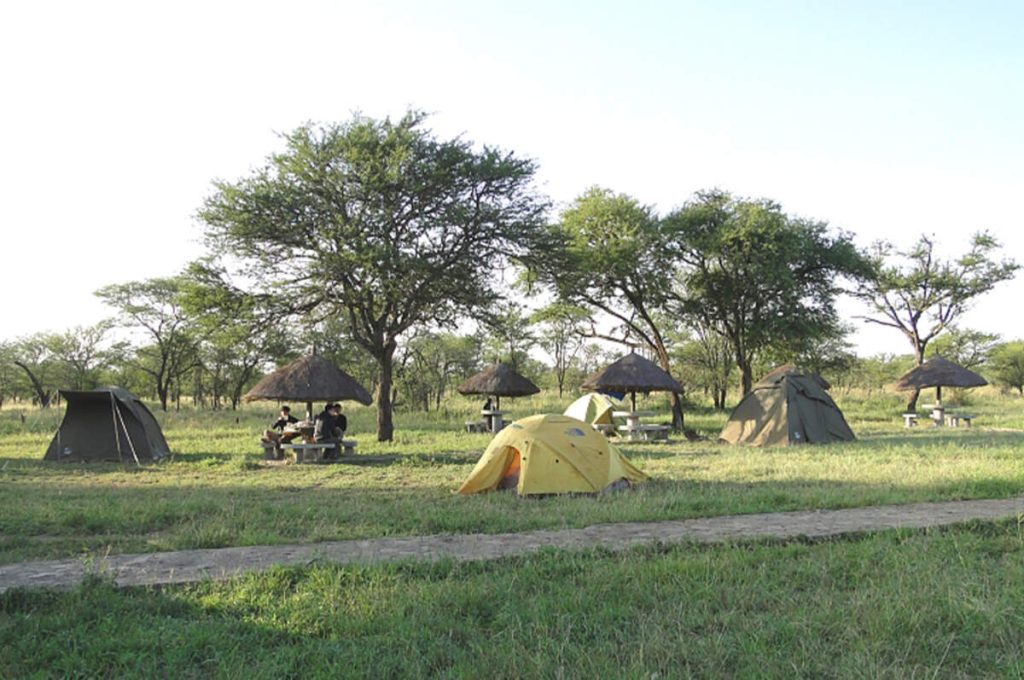
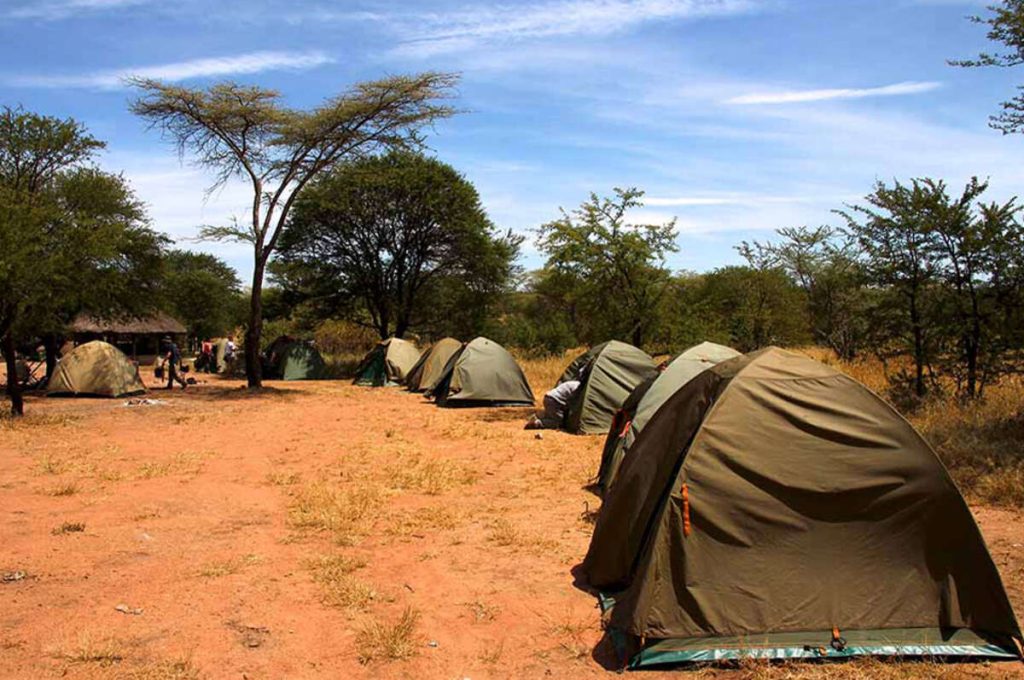
Instead of returning every evening to a city hotel, travelers remain within or close to the protected landscape. Nights are spent at recognized camps where the sounds and atmosphere of the Lowveld become part of the experience.
Camping does not mean sacrificing access to Kruger’s wildlife. Visitors explore the same protected road network and natural ecosystems as guests staying in more expensive accommodation.
The difference is mainly comfort level, facilities and price, not the wildlife.
Kruger is vast enough to contain many different ecosystems.
SANParks describes the park as nearly two million hectares, stretching across Mpumalanga and Limpopo provinces and forming part of the wider Great Limpopo Transfrontier conservation landscape. Sanparks
Vegetation changes significantly from south to north.
Southern Kruger contains productive woodland, river systems and mixed bushveld and is particularly popular for short safaris because several entrance gates and major rest camps are relatively accessible from Johannesburg and Mbombela.
Central Kruger contains extensive savannah environments and is strongly associated with large herbivore populations and predators.
Farther north, the landscape becomes increasingly remote and especially rewarding for experienced birders.
For a four-day first safari, however, trying to visit southern, central and northern Kruger would create unnecessary driving.
A stronger itinerary concentrates on one broad region and allows time for wildlife observation.
This is especially important because SANParks advises visitors not to try to cover too great a distance inside the park.
Your 4 Days Camping Kruger National Park Wildlife Safari begins from Johannesburg, Mbombela or another agreed pickup location.
For an overland Johannesburg safari, southern Kruger is particularly practical.
SANParks lists Malelane Gate at approximately 428 km from Johannesburg and advises allowing roughly four to five hours for the road journey under normal conditions. Other southern gateways include Crocodile Bridge, Numbi, Phabeni and Paul Kruger Gate. Sanparks
Travel toward South Africa’s Lowveld, where the landscape becomes progressively warmer, greener and more distinctly associated with the Kruger region.
After entering the park and completing the required formalities, the safari begins.
Even the transfer toward camp can produce wildlife.
Impalas may appear beside woodland.
Giraffes browse above surrounding vegetation.
Zebras and wildebeest occupy open areas.
Elephants may emerge suddenly from thicker bush.
Buffalo can occur singly or in substantial herds.
Kruger supports all of Africa’s traditional Big Five: lion, leopard, elephant, buffalo and rhino. SANParks also lists cheetahs, African wild dogs and spotted hyenas among its large carnivores. Sanparks
The first afternoon should remain relaxed.
There is little value in trying to locate every famous species immediately.
Instead, allow the guide to respond to current wildlife activity.
A herd of elephants interacting beside a river may deserve more time than a rushed search for another animal elsewhere.
A giraffe crossing the evening landscape can become just as memorable as a predator sighting.
Southern Kruger’s rivers and watercourses can be particularly productive.
Riverine vegetation provides shade, food and movement corridors, while water attracts many species during drier conditions.
Hippos and crocodiles occur within suitable rivers and pools.
Leopards may use dense vegetation and mature trees along watercourses, although they remain among the more difficult animals to locate.
As the afternoon light softens, the bush changes character.
Temperatures become more comfortable.
Animals may begin moving again after resting during warmer conditions.
Photography can be especially rewarding during these later hours.
Continue toward your confirmed SANParks rest camp or authorized camping facility.
SANParks provides camping sites for tents and caravans, with some sites offering electrical points and others operating more simply. Major rest camps commonly have shared ablution and kitchen facilities as well as shops and other visitor services. Sanparks
After camp check-in, settle in and enjoy the evening.
Overnight: Authorized Kruger National Park camping site, subject to confirmed availability.
Main Experience: Journey into Kruger, first wildlife drive, elephants, giraffes, buffalo and Big Five possibilities.
Wake early for the first complete wildlife day.
SANParks notes that early mornings and evenings are often among the most productive game-viewing periods, making the cooler beginning of the day especially valuable. Sanparks
The exact route should remain flexible.
Wildlife does not follow a tourist timetable.
Your guide can consider recent sightings, weather, vegetation, water availability and the animals observed during the previous afternoon.
Lions are among Kruger’s best-known predators.
SANParks estimates around 1,500 lions within the park, though their enormous range means sightings remain unpredictable. Sanparks
A pride may be resting in open shade.
Adult males may be lying close to a road.
Females may be watching surrounding herbivores.
At other times, lions can remain completely invisible within grass or woodland.
When an interesting sighting occurs, patient observation is usually more rewarding than repeatedly driving away in search of something else.
Leopards present a different challenge.
SANParks estimates approximately 1,000 leopards in Kruger, but their secretive behavior and excellent camouflage can make them difficult to locate. Sanparks
Woodland, riverine habitat and large trees can provide suitable leopard environments.
A leopard sighting should therefore be treated as an exceptional bonus rather than a guaranteed part of a four-day safari.
Elephants are much more conspicuous.
SANParks estimates approximately 17,000 elephants within Kruger. Sanparks
Possible encounters include family groups feeding through woodland, mature bulls and elephants approaching rivers or other water sources.
Give them appropriate space and allow the guide to manage the encounter according to park rules.
Buffalo are another major Big Five component, with SANParks estimating around 48,000 within the park. Sanparks
Large herds can create impressive scenes across grassland and around water.
Rhino sightings are also possible, including both black and white rhino, but conservation considerations and natural distribution mean no specific encounter should ever be promised. SANParks confirms that both species occur within Kruger. Sanparks
The safari should also make room for species outside the Big Five.
Giraffes, zebras, wildebeest, kudu, waterbuck, warthogs and impalas may feature throughout the day.
Cheetahs are possible across suitable open habitats.
African wild dogs are another particularly special possibility. They occur naturally in the park but can travel extensively, making encounters unpredictable.
Spotted hyenas may appear near open areas, predator activity or water sources.
Enjoy rest and meals according to the camping arrangement before continuing with the afternoon wildlife experience.
As temperatures begin dropping, the bush can become increasingly active again.
Return to camp before the official closing time.
SANParks requires visitors to observe camp and entrance-gate operating hours strictly and prohibits travel outside permitted times. Sanparks
Spend your second evening at camp.
Overnight: Kruger National Park camping site.
Main Experience: Full wildlife day, Big Five possibilities, predators, elephants, buffalo, antelope and river ecosystems.
Day 3 allows the safari to become more than a Big Five checklist.
After breakfast or an early wildlife departure according to the confirmed arrangement, explore a different part of the same broad Kruger region.
This is where a four-day itinerary begins to show its advantage.
You may have seen elephants repeatedly on Day 2 but no leopard.
Perhaps lions were distant.
Maybe an African wild dog pack appeared only briefly.
Perhaps wildlife was excellent but concentrated around one river system.
Day 3 gives the guide another opportunity to work with the conditions rather than relying on one short visit.
The park contains approximately 148 mammal species, so large animals represent only part of its biodiversity. Sanparks
Smaller wildlife can include mongooses, baboons, vervet monkeys, jackals and numerous antelope species.
Hippos occupy appropriate rivers and pools.
Crocodiles may be observed around permanent water.
Kruger is also a major birding destination.
SANParks’ current checklist contains 546 bird species, ranging from large raptors and vultures to rollers, bee-eaters, hornbills and wetland species. Sanparks
Even travelers who begin their safari interested mainly in lions and elephants often start noticing birds after several days.
A southern ground hornbill walking through grassland, a martial eagle overhead or a colorful roller beside the road can become a major sighting in its own right.
Day 3 should also include time to understand Kruger’s landscape.
Wildlife distribution is strongly connected to vegetation and water.
Open environments can make grazing mammals and cheetahs easier to spot.
Thicker woodland can conceal elephants and predators.
Riverine vegetation supports species that depend on shade and permanent water.
Rather than driving continuously, a patient safari may spend time observing waterholes, river crossings and productive habitat edges.
Photography also benefits from this slower approach.
Instead of creating only close wildlife portraits, capture elephants within woodland, giraffes beneath wide skies or buffalo occupying river landscapes.
These environmental photographs communicate Kruger much more effectively.
Later, return toward the selected camping site for your final night.
Depending on availability and the style of package, travelers may remain at the same camp for all three nights or use a second camp to explore another part of southern or central Kruger.
For a four-day safari, excessive camp changes should generally be avoided because packing and transfer time reduces wildlife viewing.
Overnight: Authorized Kruger camping site.
Main Experience: Deeper Kruger exploration, predators, plains wildlife, birds, waterholes and a slower safari pace.
Wake for the final morning inside Kruger.
This safari period should not be treated as a repetition of the previous days.
Wildlife may have changed location overnight.
A leopard that was impossible to find yesterday may appear near a river.
Lions may be visible close to an open area.
Elephants can move substantial distances between feeding and water habitats.
The final morning therefore remains a genuine wildlife opportunity.
Take time to appreciate species that may previously have received less attention.
Kudu, impala, giraffes and zebras form an essential part of the ecosystem.
Birdlife remains active.
Elephants and buffalo may provide one final dramatic encounter.
Predators remain possible but should never be guaranteed.
The goal is to finish the safari appreciating Kruger as a functioning ecosystem rather than worrying about whether every animal on a checklist was seen.
After the final game drive, return to camp for the agreed departure arrangements and begin traveling toward the selected exit gate.
Continue toward Mbombela, Johannesburg or another agreed destination.
Travelers departing from Johannesburg should remember that southern Kruger gates remain several hundred kilometres away. SANParks lists distances of approximately 411–475 km between Johannesburg and several southern entrances, depending on the gate. Sanparks
If connecting to an international flight, the itinerary should include a sensible travel buffer.
Your 4 Days Camping Kruger National Park – Wildlife Safari 2026-2027 then comes to an end.
Main Experience: Final morning game drive, last wildlife encounters and return journey.
Kruger is one of Africa’s best-known Big Five destinations.
SANParks confirms substantial populations of lion, leopard, elephant, buffalo, black rhino and white rhino alongside cheetah, wild dog, spotted hyena, hippo, giraffe, zebra and many antelope species. Sanparks
The park’s official current mammal checklist contains 148 species. Sanparks
This richness makes a four-day safari valuable even when one famous species remains unseen.
An African wild dog sighting can be rarer and more memorable than completing a Big Five checklist.
A herd of elephants interacting around water may provide the strongest experience of the trip.
Giraffes, kudus, baboons and birdlife also help tell the complete ecological story.
No responsible safari should guarantee the Big Five within four days.
Kruger provides excellent possibilities, not scheduled appearances.
SANParks distinguishes camping from permanent accommodation such as huts, safari tents and bungalows.
Official camping sites are designed for tents or caravans, with some providing electrical connections and others operating with simpler facilities. Sanparks
Major rest camps typically provide communal ablutions and kitchens along with facilities such as shops, restaurants or cafeterias and fuel stations. Sanparks
Some smaller satellite camps are more basic.
For example, SANParks describes Balule as a simple wilderness camp without electricity, while Maroela is specifically designed for campers and caravans. Sanparks
The precise camping experience therefore depends on which site is confirmed.
For a four-day package, travelers should check whether the quotation includes the tent, bedding or mattress, meals, campsite charges and transport rather than assuming every “camping safari” provides exactly the same services.
The major attraction is value and atmosphere.
Camping allows travelers to remain close to Kruger’s wildlife environment while keeping accommodation simpler than a lodge safari.
Kruger has two broad seasonal experiences.
SANParks describes April through September as the dry season, with generally warm dry days, colder nights and increasingly sparse vegetation. Water becomes more concentrated around rivers and waterholes, and SANParks traditionally considers this period particularly productive for game viewing. Sanparks
Camping during these months can be very pleasant during the day, but early mornings and nights may feel cold, particularly in the middle of winter.
The October through March rainy season is hotter and greener.
Summer rain transforms the landscape, producing fresh vegetation and a very different Kruger appearance. Increased foliage can make some mammals more difficult to locate, but the season is excellent for greenery and bird activity. Sanparks
Migratory birds add particular interest during the warmer months.
Neither season is universally better.
Choose the dry season for classic wildlife visibility and generally easier mammal searching.
Choose the greener season for lush landscapes, dramatic skies and especially rewarding birding.
The final price of a four-day camping safari depends on whether transportation is private or shared, the number of travelers, selected campground, meals, guided safari arrangements, starting city and conservation fees.
SANParks’ published tariff valid from 1 November 2025 through 31 October 2026 lists Kruger daily conservation fees at R602 per international adult, R300 per international child, R275 per SADC adult and R134 per South African citizen or resident adult, with reduced child rates in the latter categories. Sanparks
Those figures are conservation fees, not a complete four-day safari price.
Camping accommodation, transportation, guiding, meals and other services are separate.
SANParks also applies a 1% community fund to accommodation and activity reservations. Sanparks
Because the currently published Kruger tariff ends on 31 October 2026, travelers whose safari falls after that date or during 2027 should use the new official tariff applicable to their exact dates rather than assuming the 2025-2026 rates remain unchanged.
A complete quotation should therefore be based on:
travel dates + visitor category + campsite availability + group size + transport + guiding + meals.
Johannesburg is a practical starting point for an overland Kruger safari.
SANParks lists the southern entrances between approximately 411 and 475 km from Johannesburg, depending on the gate. Malelane is approximately 428 km away, while Crocodile Bridge is approximately 475 km. Sanparks
For a four-day road safari, using southern Kruger reduces the amount of unnecessary internal driving.
Another option is to fly closer to the park.
SANParks lists scheduled air access to Skukuza Airport and Kruger Mpumalanga International Airport, as well as airports serving other parts of the Kruger region. Sanparks
Flying can protect more wildlife time but normally increases the trip cost.
The best choice depends on whether the priority is budget, scenery during the overland journey or maximum time inside Kruger.
Kruger is one of southern Africa’s great birding destinations.
SANParks’ current checklist contains 546 species and highlights birds including hornbills, rollers, bee-eaters, vultures and eagles. Sanparks
The park’s famous birding “Big Six” includes the saddle-billed stork, kori bustard, martial eagle, lappet-faced vulture, Pel’s fishing owl and southern ground hornbill. Sanparks
Photography is equally varied.
Possible subjects include:
lions in savannah, elephants around rivers, leopards in woodland, giraffes against open skies, buffalo herds, rhinos, colorful birds and African sunsets.
Wide photographs are often more meaningful than endless close-ups.
Including vegetation, rivers or the Lowveld horizon immediately identifies the environment in which an animal lives.
Wildlife should always be photographed without disturbing it.
SANParks prohibits off-road driving without authorization, feeding or disturbing animals and leaving vehicles in undesignated areas. Sanparks
Camping inside a major wildlife reserve requires respect for park regulations.
SANParks requires overnight visitors to stay at booked and recognized overnight facilities, follow camp and gate times and avoid feeding or disturbing wildlife. Sanparks
Visitors should follow camp staff and guide instructions, especially after dark.
Food should be managed properly because SANParks specifically warns that monkeys and baboons may take unattended food. Sanparks
Noise restrictions also protect both wildlife and other visitors.
The objective of a camping safari is not to turn the wilderness into an outdoor party environment.
A good campsite experience is quiet, low-impact and respectful of the protected landscape.
Is four days enough for Kruger National Park? Yes. Four days provides an arrival safari, two substantial wildlife days and a final morning game drive. Longer stays allow more regions of the enormous park to be explored.
Can I see the Big Five in four days? Kruger supports lion, leopard, elephant, buffalo, black rhino and white rhino, so Big Five sightings are possible, but no individual species can be guaranteed. Sanparks
How large is Kruger National Park? SANParks describes Kruger as covering nearly two million hectares. Sanparks
How many mammal species are found in Kruger? SANParks’ current checklist contains 148 mammal species. Sanparks
How many bird species occur in Kruger? The current SANParks checklist contains 546 species. Sanparks
Can I see African wild dogs? Yes. African wild dogs occur naturally in Kruger, but their movements can make sightings unpredictable. Sanparks
What facilities do Kruger camping sites have? Facilities vary by camp. Major rest camps generally provide communal ablutions, kitchens and other visitor services, while some smaller camps are considerably more basic. Sanparks
What is the best time for wildlife viewing? SANParks identifies April through September as the dry season and traditionally the strongest period for easier game viewing because vegetation is thinner and animals depend more heavily on limited water. Sanparks
Can the safari start from Johannesburg? Yes. SANParks lists several southern Kruger gates roughly 411–475 km from Johannesburg. Sanparks
Can I fly closer to Kruger instead? Yes. Airports including Skukuza and Kruger Mpumalanga International Airport serve the wider Kruger region. Sanparks
Is camping cheaper than lodge accommodation? It generally can be, but the full trip cost depends on campsite, transportation, guiding, meals, conservation fees and group size.
Is wildlife guaranteed? No. Kruger is a natural ecosystem, and every sighting depends on animal movement, habitat, weather and season.
The itinerary succeeds by resisting the temptation to cross an enormous national park in only four days.
Day 1 becomes:
Johannesburg/Mbombela → Kruger → first elephants and plains wildlife → camping.
Day 2 becomes:
Full wildlife safari → lions → elephants → buffalo → leopard and rhino possibilities → river systems.
Day 3 becomes:
Deeper Kruger exploration → predators → giraffes → antelope → wild-dog possibilities → birdlife → final camping night.
Day 4 becomes:
Morning safari → final wildlife encounters → Johannesburg/Mbombela.
That creates repeated wildlife opportunities while keeping enough time for observation rather than spending most of the safari racing between distant camps.
The 4 Days Camping Kruger National Park – Wildlife Safari 2026-2027 begins with a journey into the South African Lowveld and one of Africa’s greatest wildlife landscapes.
Enter Kruger and immediately begin searching for elephants, giraffes, buffalo and antelope.
Spend the next days exploring savannah, woodland and river systems where lions, leopards, rhinos, cheetahs, spotted hyenas and African wild dogs may occur.
Return each evening to an authorized camping facility and experience the quieter atmosphere of Kruger after the day’s game drives are complete.
Wake for one final morning wildlife experience before leaving the park.
The complete journey follows:
Johannesburg/Mbombela → Southern Kruger National Park → Wildlife Game Drives → Kruger Camping → Full-Day Safari → Final Morning Safari → Johannesburg/Mbombela
The final 2026-2027 price should be calculated according to the exact travel dates, number of travelers, starting point, visitor category, camping arrangement, private or shared safari format and the SANParks tariffs applying to those dates.
The journey can remain a focused four-day camping safari or be extended to provide additional nights in southern or central Kruger, allowing a slower pace and more time for wildlife, birding and photography.
Spend four days discovering Big Five wildlife, elephants, predators, African wild dogs, more than 500 bird species and the changing landscapes of South Africa’s Lowveld, while camping within or close to the wilderness and giving Kruger enough time to reveal why it remains one of Africa’s great safari destinations.
No results available
ResetNo results available
ResetTanzania is a year-round safari destination with many adventures being offered all over the country. For optimal wildlife sightings, the dry season from June to October is your best bet! Read more on when to visit Tanzania
Both have their perks with Big Five national parks, the incredible Great Migration and that quintessential African experience we all dream of. Check out our article on Serengeti vs Masai Mara to help you decide.
They both have such different safari experiences! Tanzania offers Big Five game reserves on classic dusty desert plains, rather South Africa partners the Big Five animals with luscious winelands. Both are just as good, but it depends on your safari style.
That’s a tough one! Botswana is home to herds of elephants at Chobe and the sparkling Okavango Delta, and Tanzania has the iconic Mount Kilimanjaro and Great Migration. Check out our article on Botswana vs Tanzania safaris to help you decide.
Tanzania is in general a safe, hassle-free country. However, like most places, you do need to take precautions and listen to your tour guide. It also pays to read our articles on ‘Things to know before going to Tanzania’.
A camera and binoculars are a must. You’ll regret it if you don’t take them! As for clothing, definitely pack lightweight, breathable clothing. Remember, Tanzania is an arid country so the days can get quite hot. Read more on what to pack for a safari in Tanzania in our travel magazine
EXPERIENCES
BEST TOURS
copyright©2026 . Enjore Safaris