
The 4 Days Best of Gorilla Tracking Safari in Uganda – A Lifetime Wildlife Encounter 2026-2027 is a focused primate safari into the ancient rainforest of Bwindi Impenetrable National Park, home to one of the world’s most important populations of endangered mountain gorillas.
Rather than trying to combine several distant Ugandan national parks within only four days, this itinerary places Bwindi and the mountain-gorilla experience at the center of the journey. Travelers have time to reach southwestern Uganda comfortably, spend a full day dedicated to gorilla tracking, experience the surrounding forest and community landscape, and return to Kampala or Entebbe without turning every day into a long transfer.
Bwindi covers approximately 321 km² in southwestern Uganda. UNESCO inscribed the park as a World Heritage Site in 1994 because of its extraordinary biodiversity, ancient Afromontane forest and global importance for endangered mountain gorillas. UNESCO World Heritage Centre
Kampala/Entebbe → Southwestern Uganda → Bwindi Impenetrable National Park → Mountain Gorilla Tracking → Forest and Community Experience → Kampala/Entebbe
The journey progresses through:
Ugandan countryside → southwestern highlands → ancient rainforest → mountain gorillas → forest biodiversity → community conservation → return to Entebbe/Kampala.
For travelers planning a Uganda gorilla safari in 2026 or 2027, four days provides a particularly good balance between travel time and the main wildlife encounter.
A three-day Bwindi safari is possible, but road travelers spend a large portion of Day 1 and Day 3 transferring between Kampala or Entebbe and southwestern Uganda.
Adding a fourth day creates a more relaxed experience.
Day 1 becomes the journey to Bwindi.
Day 2 is devoted to mountain-gorilla tracking.
Day 3 allows travelers to remain in the Bwindi landscape for a slower forest, birding or community-based experience.
Day 4 is reserved for the return journey.
That structure makes the safari feel like a holiday rather than simply transportation surrounding one gorilla permit.
It also provides some flexibility around accommodation and the four main Bwindi tracking sectors: Buhoma, Ruhija, Rushaga and Nkuringo. Uganda Wildlife Authority currently identifies all four as official gorilla-tracking entry areas. Uganda Wildlife Authority
Bwindi is much more than a gorilla-tracking destination.
UNESCO describes the park as one of East Africa’s most important surviving areas of Afromontane lowland forest. Its World Heritage property covers 32,092 hectares and contains exceptional diversity of trees, ferns, butterflies, birds and mammals. UNESCO World Heritage Centre
The forest lies along the eastern edge of the Albertine Rift and contains habitats ranging from lower forest to higher montane environments.
Mountain gorillas are its most famous residents, but Bwindi also supports chimpanzees, monkeys, forest elephants, duikers and a remarkable bird community.
Uganda Wildlife Authority reported in September 2026 that the last completed official Bwindi mountain-gorilla census, conducted in 2018, counted 459 individuals. UWA also confirmed that newer 2025/2026 genetic census work had been completed but the updated population analysis had not yet been released at that time. Uganda Wildlife Authority
This distinction is important for accurate 2026-2027 travel information.
Rather than describing 459 as a brand-new population estimate, it is more accurate to treat it as the latest published benchmark while awaiting the new genetic census result.

Your 4 Days Best of Gorilla Tracking Safari in Uganda begins in Kampala, Entebbe or another agreed pickup location.
Meet your professional Uganda safari driver-guide and begin traveling toward southwestern Uganda.
The road journey is substantial, so Day 1 should be treated primarily as a transfer and landscape day rather than being overloaded with additional activities.
Uganda Wildlife Authority lists several road approaches to Bwindi. The northern Buhoma route, for example, uses the Kampala–Ntungamo–Rukungiri–Kihihi corridor, while the southern sectors are approached through the Kabale and Kisoro region. The exact route should therefore match the tracking sector shown on the gorilla permit. Uganda Wildlife Authority
As the journey continues southwest, the landscape changes.
Uganda’s central countryside gradually gives way to greener highlands.
Agricultural slopes, valleys and increasingly dramatic hills characterize the final approach toward Bwindi.
The relationship between the forest and the surrounding communities becomes particularly visible here.
Bwindi survives as a dense block of protected rainforest surrounded by heavily cultivated land, one reason UNESCO considers both conservation and community involvement essential to the park’s future. UNESCO World Heritage Centre
Arrive at your selected lodge near the assigned tracking sector.
A good four-day package should match accommodation with the actual gorilla permit sector, rather than booking a lodge first and discovering later that the tracking entry point is far away.
Check in, enjoy the forest or highland atmosphere and have dinner.
The evening should remain relaxed because the next day contains the main wildlife experience.
Overnight: Bwindi area, matched to the assigned gorilla-tracking sector.
Main Experience: Southwestern Uganda landscapes, arrival in the Bwindi conservation area and preparation for the gorilla experience.
Wake early near Bwindi and enjoy breakfast before traveling to the designated Uganda Wildlife Authority visitor center for your assigned gorilla-tracking sector.
UWA conducts gorilla tracking through authorized entry points in Buhoma, Ruhija, Rushaga and Nkuringo. Visitors first receive an official briefing before entering the forest under ranger guidance. Uganda Wildlife Authority
The forest experience begins long before gorillas appear.
Dense vegetation, enormous trees, vines, ferns and changing elevation create an atmosphere completely different from a classic savannah safari.
Bird calls come from the canopy.
Monkeys may move through trees.
Forest light changes continuously as clouds and vegetation filter the sun.
The amount of time required to locate a habituated gorilla family varies because the animals move naturally through the forest. UWA currently describes a typical tracking experience as potentially lasting roughly two to seven hours, depending on where the assigned gorilla family has moved. Uganda Wildlife Authority
This is why realistic expectations matter.
Gorilla tracking is not a scheduled zoo encounter.
The animals are free-ranging.
Their daily movements depend on feeding, social behavior and the forest environment.
Once the assigned habituated gorilla group is located, current UWA rules allow standard tracking visitors a maximum of one hour of observation. Uganda Wildlife Authority
That hour can become the defining experience of the safari.
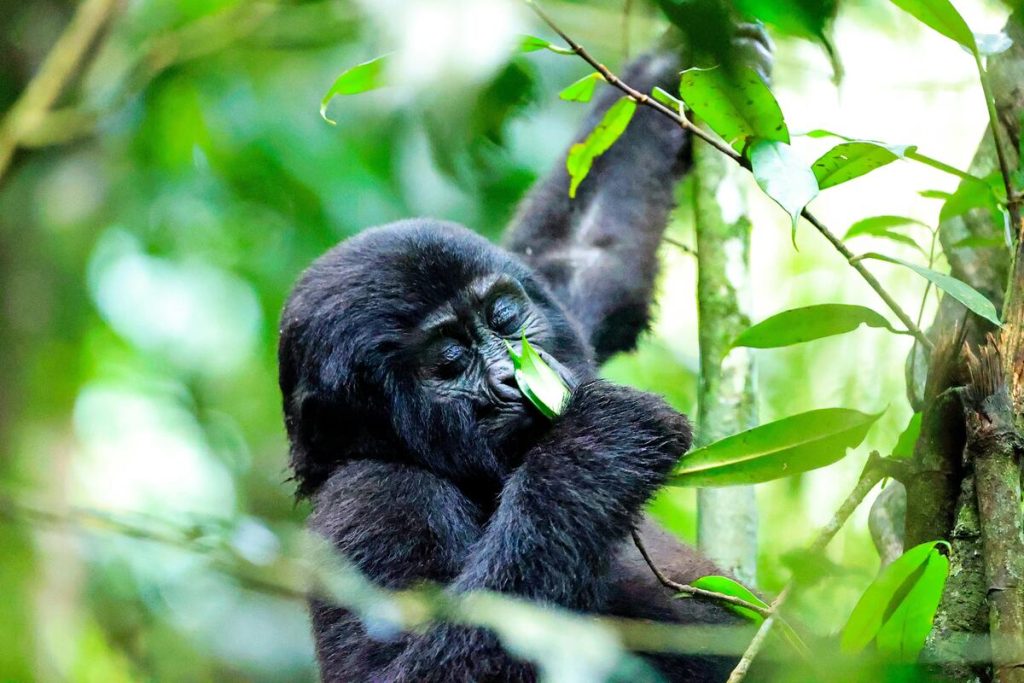
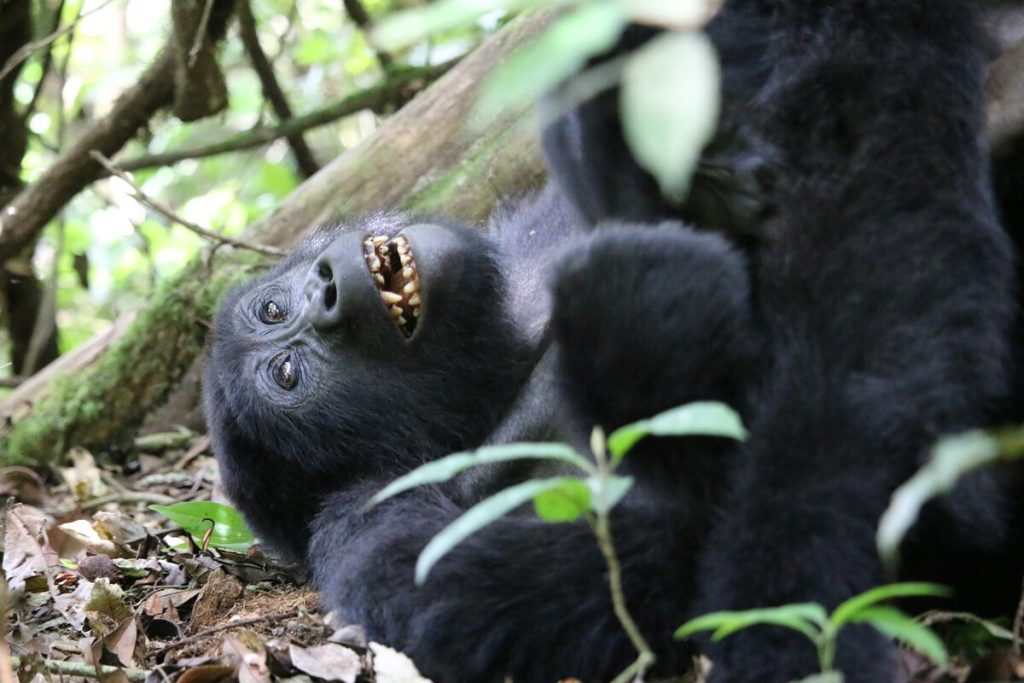
A silverback may rest quietly while other members feed nearby.
Younger gorillas may interact within the vegetation.
Adults may move between feeding areas.
Sometimes the entire family is relatively visible.
On other occasions, the rainforest itself becomes part of the scene, with animals partly framed by leaves and branches.
The experience should remain observational.
These are endangered wild primates rather than animals performing for visitors.
Current UWA regulations set the minimum age for gorilla tracking at 15 years. The rules also limit normal visits to one hour and require guests to follow ranger instructions designed to reduce disturbance and disease transmission. Uganda Wildlife Authority
Human health is particularly important because gorillas can be vulnerable to diseases carried by people.
Visitors who are unwell with an infectious illness should not participate, and UWA rules also prohibit flash photography during the encounter. Uganda Wildlife Authority
After completing the tracking experience, return from the forest with your ranger group.
The rest of the afternoon should remain flexible.
After several hours in a humid mountain forest, many travelers prefer to return to the lodge, have lunch and relax rather than immediately beginning another major excursion.
This slower pacing is one of the advantages of choosing four days rather than three.
Spend the evening surrounded by the Bwindi landscape and enjoy dinner.
Overnight: Bwindi area
Main Experience: Uganda Wildlife Authority briefing, guided rainforest tracking and up to one hour observing a habituated mountain-gorilla family after the encounter.
After breakfast, Day 3 provides a slower opportunity to understand Bwindi beyond its gorillas.
The exact experience can be selected according to the accommodation sector, current park arrangements and traveler interests.
A guided nature or birding experience can introduce the wider biodiversity of the forest without trying to repeat the previous day’s gorilla encounter.
UNESCO records Bwindi as one of Africa’s major biodiversity hotspots, with more than 200 tree species, over 100 fern species and an exceptional concentration of Albertine Rift wildlife. Its World Heritage listing specifically recognizes both its biological richness and importance for threatened species. UNESCO World Heritage Centre
Birding is particularly rewarding.
Bwindi supports an exceptional forest bird community and is internationally important for species associated with the Albertine Rift.
The forest also contains other primates.
Chimpanzees are part of Bwindi’s wildlife community, and a dedicated 2025 survey produced an estimated 426 chimpanzees distributed across the park. The results were officially announced by UWA in February 2026. Uganda Wildlife Authority
Chimpanzees should not be confused with the standard Bwindi gorilla-tracking experience. The important point is that the park protects a much broader great-ape and forest ecosystem.
Another worthwhile Day 3 option is a community-led cultural experience around the park.
Bwindi’s conservation story is closely linked to surrounding communities. UNESCO emphasizes that local benefits from tourism and conservation are essential because the forest is surrounded by a densely populated agricultural landscape. UNESCO World Heritage Centre
A responsible community experience should therefore be organized through local guides and community initiatives rather than treating people as attractions.
Depending on the sector, the afternoon can remain free for lodge relaxation, landscape photography or another approved nature experience.
This day deliberately avoids an exhausting schedule.
The main gorilla encounter happened on Day 2.
Day 3 allows travelers to appreciate why the forest itself matters.
Return to the lodge for dinner and your final night in southwestern Uganda.
Overnight: Bwindi area
Main Experience: Bwindi biodiversity, forest scenery, birdlife and responsible community-based tourism.
Enjoy breakfast before leaving the Bwindi region.
The return journey travels back through southwestern and central Uganda toward Kampala or Entebbe.
For travelers using the road itinerary, this is another substantial transfer day.
The exact journey time depends on the starting sector, road conditions, traffic and final destination.
UWA’s current access information shows that different Bwindi sectors have significantly different road approaches, so transfer planning should be based on the actual lodge and permit location rather than one universal advertised driving time. Uganda Wildlife Authority
Travelers wanting to reduce road time can consider an air version of the itinerary.
UWA states that scheduled and charter flights connect Entebbe with Kihihi Airstrip for the northern Bwindi area and Kisoro Airstrip for southern sectors such as Rushaga and Nkuringo, with onward road transfers still required. Uganda Wildlife Authority
Arrive in Kampala, Entebbe or your agreed destination and complete the 4 Days Best of Gorilla Tracking Safari in Uganda – A Lifetime Wildlife Encounter 2026-2027.
Main Experience: Final Bwindi scenery and return to Kampala or Entebbe.
Bwindi is not one small entrance where every traveler begins the same trek.
Uganda Wildlife Authority recognizes four principal tracking sectors:
Buhoma, Ruhija, Rushaga and Nkuringo. Uganda Wildlife Authority
This matters for accommodation.
A gorilla permit is associated with a tracking area, and staying near the correct sector makes the morning far easier.
Buhoma lies in the northern part of Bwindi.
Ruhija serves the eastern forest.
Rushaga and Nkuringo are in the south.
Travelers should therefore confirm the permit sector before finalizing accommodation.
For a four-day package, good planning follows this order:
travel dates → permit availability and sector → accommodation → transport arrangements.
Not the other way around.
The gorilla permit is one of the largest components of a Uganda gorilla-safari budget.
Uganda Wildlife Authority introduced discounted low-season gorilla-tracking permits for April, May and November, with rates of US$600 for Foreign Non-Residents and US$500 for Foreign Residents. UWA stated that these discounted rates took immediate effect in 2026. Uganda Wildlife Authority
UWA also announced a revised standard tariff effective 1 January 2027. The published 2027 gorilla-tracking rates are US$800 for Foreign Non-Residents, US$700 for Foreign Residents, US$500 for Rest-of-Africa visitors and UGX 300,000 for East African Community citizens. Uganda Wildlife Authority
For 2026 travel dates outside the specifically announced low-season months, the applicable rate should be confirmed when securing the permit because the February 2026 notice separately introduces the discount and sets the revised general tariff to begin in January 2027.
Another major change occurred on 1 March 2026: UWA suspended the previous seven-day unpaid permit-reservation window. Permits are now secured through payment at booking rather than being held temporarily without payment. Uganda Wildlife Authority
That makes early confirmation especially important for fixed travel dates.
A gorilla permit is not the complete price of the four-day safari.
The final package can additionally include road or air transportation, professional guiding, accommodation, meals and other agreed services.
Bwindi can be visited throughout the year.
The main difference between seasons is generally the condition of the forest rather than whether mountain gorillas suddenly disappear.
Uganda Wildlife Authority broadly identifies June through August and December through February as drier periods that are often favorable for primate tracking and wildlife travel. Wetter conditions can make forest trails muddier, while the rainforest remains lush throughout the year. Uganda Wildlife Authority
Bwindi itself receives substantial rainfall because it is a mountain rainforest.
Even during generally drier months, visitors should be prepared for changing conditions.
The wetter periods can still be rewarding.
The forest becomes intensely green.
Cloud and mist create dramatic scenery.
Birdlife remains important.
For 2026-2027, another consideration is permit pricing. April, May and November now have official UWA low-season gorilla-tracking discounts for eligible foreign visitor categories. Uganda Wildlife Authority
The best travel date therefore depends on the balance between weather, permit availability, price and the wider Uganda itinerary.
Most African wildlife safaris are vehicle-based.
Gorilla tracking is completely different.
The experience happens inside dense mountain forest under ranger supervision.
The objective is not to cover enormous distances or collect a long wildlife checklist.
Instead, the entire day builds toward time with one habituated mountain-gorilla family.
That makes the experience more intimate and conservation-focused.
There may be moments when very little is visible beyond trees and vegetation.
Then a gorilla suddenly appears through the forest.
The animal may remain partly hidden.
That is not a failure of the experience.
The rainforest is the gorilla’s natural home, and seeing the species within that habitat is precisely what makes Bwindi extraordinary.
The strongest expectation is therefore:
forest experience first, gorilla encounter as the extraordinary centerpiece.
Bwindi offers accommodation for different travel budgets around its various tracking sectors.
Budget travelers can use practical guesthouses and simpler lodges.
Mid-range properties generally provide private rooms, en-suite facilities and comfortable meals within convenient reach of the forest.
Luxury lodges may provide more privacy, larger rooms, forest views and premium service.
However, an expensive lodge in the wrong sector can create a worse itinerary than a simpler property positioned near the correct tracking entrance.
For a four-day gorilla safari, the priorities should be:
correct sector + reliable transport + comfortable accommodation + confirmed permit.
A private road safari provides flexibility during transfers, while a fly-in arrangement is useful for travelers wanting to reduce the long road journeys between Entebbe and southwestern Uganda.
Mountain gorilla tourism exists within a carefully managed conservation system.
The animals are habituated to controlled human presence, but they remain wild.
Uganda Wildlife Authority’s current regulations limit standard viewing to one hour, set the minimum tracking age at 15, restrict the number of visitors around a habituated group and require compliance with health and photography rules. Uganda Wildlife Authority
These rules protect both people and gorillas.
Disease transmission is particularly important because of the biological similarities between humans and great apes.
Travelers who are ill should not participate.
Flash photography is prohibited.
Visitors must follow the ranger rather than trying to move independently toward animals.
Responsible tourism also extends beyond the forest.
Bwindi is surrounded by communities whose relationship with conservation is crucial to the park’s future. UNESCO specifically notes the importance of tourism benefits and community support in maintaining this globally significant forest. UNESCO World Heritage Centre
Four days works best as a Bwindi-focused gorilla safari.
Travelers with additional time can create a much broader Uganda itinerary.
One strong extension is Queen Elizabeth National Park, adding elephants, buffalo, lions, Uganda kob and the Kazinga Channel before continuing to Bwindi.
Another is Kibale National Park, allowing travelers to combine mountain gorillas with chimpanzee tracking.
A longer primate-and-wildlife itinerary could therefore follow:
Kibale → Queen Elizabeth → Bwindi.
The important principle is to add days whenever adding major destinations.
Trying to combine Kibale, Queen Elizabeth and Bwindi properly in only four days would create too much road travel and too little time experiencing the parks.
Is four days enough for a Uganda gorilla safari? Yes. Four days provides a comfortable focused itinerary with a transfer to Bwindi, a full gorilla-tracking day, an additional day around the forest and a return to Kampala or Entebbe.
Where does gorilla tracking take place in Uganda? Uganda Wildlife Authority conducts mountain-gorilla tracking in Bwindi Impenetrable National Park and Mgahinga Gorilla National Park. This four-day itinerary focuses on Bwindi. Uganda Wildlife Authority
What are the four Bwindi tracking sectors? They are Buhoma, Ruhija, Rushaga and Nkuringo. Uganda Wildlife Authority
What is the minimum age for gorilla tracking? Current UWA rules set the minimum age at 15 years. Uganda Wildlife Authority
How long can visitors watch the gorillas? Standard gorilla tracking allows a maximum of one hour with the habituated family after the encounter. Uganda Wildlife Authority
How much is a Uganda gorilla permit in 2027? From 1 January 2027, UWA lists US$800 for Foreign Non-Residents, US$700 for Foreign Residents, US$500 for Rest-of-Africa visitors and UGX 300,000 for EAC citizens. Uganda Wildlife Authority
Does Uganda offer discounted gorilla permits? UWA introduced low-season rates for April, May and November, including US$600 for Foreign Non-Residents and US$500 for Foreign Residents. Uganda Wildlife Authority
Are gorilla sightings guaranteed? No wildlife encounter should be described as absolutely guaranteed. Bwindi tracking uses habituated gorilla families monitored by UWA, but the animals remain free-ranging wildlife.
How many mountain gorillas are in Bwindi? The most recent published benchmark remains 459 gorillas from the 2018 census. UWA stated in September 2026 that analysis of the newer 2025/2026 genetic census was still awaiting release. Uganda Wildlife Authority
Can I fly to Bwindi instead of driving? Yes. UWA lists air access from Entebbe to Kihihi for northern Bwindi and Kisoro for southern sectors, followed by road transfers to the lodge. Uganda Wildlife Authority
Can the safari be combined with Queen Elizabeth or Kibale? Yes, but additional days are recommended so that each destination receives enough time.
Is Bwindi only about gorillas? No. It is a UNESCO World Heritage biodiversity hotspot containing exceptional forest, birds, butterflies, other primates and numerous threatened species. UNESCO World Heritage Centre
The itinerary keeps the journey focused on the reason travelers choose southwestern Uganda: Bwindi and its mountain gorillas.
Day 1 becomes:
Kampala/Entebbe → southwestern Uganda → Bwindi rainforest → lodge.
Day 2 becomes:
UWA briefing → guided forest tracking → mountain gorilla encounter → Bwindi lodge.
Day 3 becomes:
Forest biodiversity → birdlife → community conservation → relaxed Bwindi experience.
Day 4 becomes:
Bwindi → western Uganda scenery → Kampala/Entebbe.
The result provides enough time for the principal wildlife encounter without rushing immediately into another distant park.
The 4 Days Best of Gorilla Tracking Safari in Uganda – A Lifetime Wildlife Encounter 2026-2027 begins in Kampala or Entebbe and travels toward the forested highlands of southwestern Uganda.
As the journey approaches Bwindi, farms and villages surround increasingly dramatic hills before one of East Africa’s great surviving rainforests appears.
Spend the first evening close to the forest.
The following day, enter Bwindi with Uganda Wildlife Authority rangers.
Move through ancient vegetation while listening to birds and forest sounds.
Then, when the assigned habituated gorilla family is located, spend the authorized observation period watching mountain gorillas living naturally within their rainforest home.
The following day provides time to discover the wider Bwindi landscape through responsible forest, birding or community experiences instead of immediately beginning another long transfer.
Finally, leave the rainforest and return toward Kampala or Entebbe.
The complete four-day journey follows:
Kampala/Entebbe → Bwindi Impenetrable National Park → Gorilla Tracking → Bwindi Forest & Community Experience → Kampala/Entebbe
The final price should be calculated according to the exact travel dates, visitor category, gorilla-permit rate, assigned Bwindi sector, road or fly-in arrangement, number of travelers and selected accommodation level.
The four-day itinerary can remain fully focused on Bwindi or expand with additional days for Queen Elizabeth National Park, Kibale National Park or a broader western Uganda wildlife journey.
Travel into UNESCO-listed Bwindi Impenetrable National Park, experience its remarkable biodiversity and spend an unforgettable authorized hour observing a habituated mountain-gorilla family within one of Africa’s most important surviving rainforest ecosystems.
No results available
ResetNo results available
ResetTanzania is a year-round safari destination with many adventures being offered all over the country. For optimal wildlife sightings, the dry season from June to October is your best bet! Read more on when to visit Tanzania
Both have their perks with Big Five national parks, the incredible Great Migration and that quintessential African experience we all dream of. Check out our article on Serengeti vs Masai Mara to help you decide.
They both have such different safari experiences! Tanzania offers Big Five game reserves on classic dusty desert plains, rather South Africa partners the Big Five animals with luscious winelands. Both are just as good, but it depends on your safari style.
That’s a tough one! Botswana is home to herds of elephants at Chobe and the sparkling Okavango Delta, and Tanzania has the iconic Mount Kilimanjaro and Great Migration. Check out our article on Botswana vs Tanzania safaris to help you decide.
Tanzania is in general a safe, hassle-free country. However, like most places, you do need to take precautions and listen to your tour guide. It also pays to read our articles on ‘Things to know before going to Tanzania’.
A camera and binoculars are a must. You’ll regret it if you don’t take them! As for clothing, definitely pack lightweight, breathable clothing. Remember, Tanzania is an arid country so the days can get quite hot. Read more on what to pack for a safari in Tanzania in our travel magazine
EXPERIENCES
BEST TOURS
copyright©2026 . Enjore Safaris